






Investors have been receiving mixed signals from the market and the economy lately, making this a confusing time to plan for the future.
The S&P 500 (^GSPC +1.20%) recently reached a new all-time high, just two weeks after it hit its lowest point of the year. Also, while many economists are raising the odds of a recession in the next year due to rising oil prices, the Federal Reserve has opted to hold interest rates steady — which is good news for investors.
Here’s what experts are saying about a recession, as well as what that means for your financial future.

Image source: Getty Images.
Recession risks are increasing
Economists at the International Monetary Fund noted that the war in Iran could slow global economic growth, warning that persistently high oil prices could potentially push inflation to 6% by next year.
Chief economist Pierre-Olivier Gourinchas also told the BBC in an interview that this oil crisis could rival that of the 1970s, while also elevating unemployment and food insecurity in some countries.
Experts at Vanguard have similar predictions. In a March report, they forecast that oil prices would need to remain elevated at $150 per barrel to trigger a U.S. recession. Even if oil prices remain only slightly above prewar levels for a few months, it could still slow U.S. GDP and push inflation up by around 0.4%, researchers found.
Still, though, the risk of a recession is moderately low right now. In March, Goldman Sachs predicted a 30% chance of a recession beginning in the next 12 months. While that’s an increase from its previous forecast of 25%, it doesn’t mean a recession is a sure thing.
What does this mean for investors?
During periods of economic uncertainty, a long-term outlook is more important than ever.
Much of the uncertainty around a potential recession stems from the war in Iran, and nobody knows how long that might last. If it’s resolved relatively quickly, oil prices may cool and recession odds may drop significantly. But if it goes on for many more months or even years, it could take a much bigger toll on the economy.
In times like these, it can be helpful to remember that this isn’t the first time the market has experienced an oil crisis, war, or surging inflation. Even if we face a recession in 2026 or beyond, the market is very likely to recover over time.
Since 2000, the U.S. has experienced everything from the dot-com bubble burst to a decades-long war in the Middle East to the Great Recession to a global pandemic, with many smaller challenges along the way. In that time, however, the S&P 500 has earned total returns of around 675%.
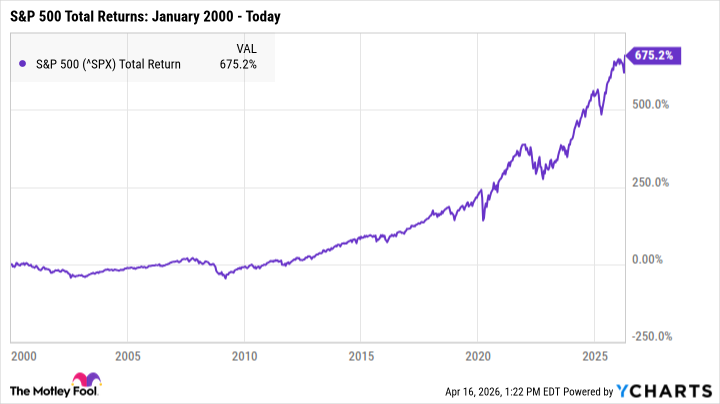
The investors who reaped the biggest rewards were those who continued investing even during the uncertain periods. Warren Buffett perhaps said it best in a 2008 opinion piece for The New York Times, as he explained his investing strategy amid the Great Recession.
“You might think it would have been impossible for an investor to lose money during a century marked by such an extraordinary gain,” he noted, speaking of the Dow Jones Industrial Average‘s meteoric rise from 66 to 11,497 throughout the 20th century. “But some investors did. The hapless ones bought stocks only when they felt comfort in doing so and then proceeded to sell when the headlines made them queasy.”
If the headlines are making you queasy right now, that’s normal. But the stock market has a century-long track record of surviving all types of volatility. Staying invested for at least a few years — regardless of what’s in store for the market — can limit risk while also setting you up for potentially lucrative gains.