








Elon Musk’s X lets you write long-form content on the platform through its Articles feature, but only if you’re a paid subscriber or business. The decentralized social networking startup Bluesky has a different idea.
On Thursday, Bluesky rolled out a new version of its app that integrates with Standard.site, a community project for building long-form content on the same underlying protocol that powers Bluesky.
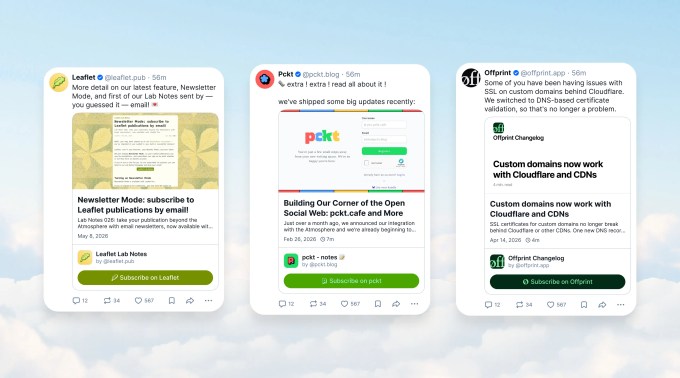
This means Bluesky users can now explore content beyond microblogs, or the short posts that Bluesky is known for. Instead, they can read articles, blog posts, and newsletters published across the wider network of AT Protocol-powered apps, known as the “Atmosphere.” That includes sites like Leaflet, pckt, and Offprint, which cater to independent writers and publishers who want to own their content and expand their distribution across the open web.
These articles will initially appear as dynamic link cards — essentially, an enhanced preview. Bluesky says this is just a first step, and the functionality will be improved over time.

This marks the second expansion of Bluesky’s capabilities based on other projects built by community members. In February, a startup called Germ became the first private messaging service that could launch directly from Bluesky’s app, thanks to a similar integration.
By building the technology infrastructure alongside its social networking client application, Bluesky is able to leverage the other apps and services also running on the AT Protocol. That’s not a bad deal for the third parties, either, as they can tap into the distribution provided by Bluesky’s network of some 44.5 million registered users.
The expansion to long-form content follows shortly after WordPress’s announcement earlier this month of its own plugin that allows any WordPress site to publish to the Atmosphere. (The plugin joins another WordPress already offered for publishing to the open social services that are powered by a different protocol, ActivityPub, such as Mastodon.)
Like Bluesky, WordPress’s integration relied on Standard.site’s lexion records, which basically means that your blog becomes data on the AT Protocol itself, instead of just a link you’re sharing on an app like Bluesky. Because of this, any app compatible with the AT Protocol could allow its users to read WordPress blog posts.
With this integration now coming to Bluesky, you can see more of the startup’s vision for the open social web — one where data itself is open and freely distributable, accessible from any client, and where users can move between personal data servers (PDS) at will. (Though Bluesky was the first PDS, there are now others to choose from, including those offered by Eurosky, Blacksky, Northsky, and others.)
That’s certainly different from X’s approach to content, long-form or otherwise, which remains siloed in its app and is only able to be embedded elsewhere on the web.
However, the advantage that X offers in terms of distribution is its 550 million monthly active users — something that Bluesky’s open social rival may never be able to beat.
The updated version of Bluesky (v1.122) also includes a handful of other features, the company noted, including a refreshed GIF picker and photo viewer, and expanded moderation labeling at the account level, and a fix for a bug that was silently dropping some iOS video uploads.
When you purchase through links in our articles, we may earn a small commission. This doesn’t affect our editorial independence.