








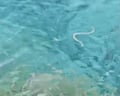
Irrefutable proof of what Spanish researchers and wildlife experts had long suspected, and long feared, finally presented itself in the form of a grainy video that was shot on a minuscule island in the Balearics in April 2024.
Ribboning its way through the turquoise waters that separate the east coast of Ibiza from the islet of Santa Eulària 450 metres away, came a pale and solitary horseshoe whip snake in search of new territory and fresh sustenance.
The arrival of the snake on Santa Eulària, recorded by a local wildlife ranger, confirmed that the insatiable invader from the Spanish mainland – which has almost wiped out Ibiza’s endemic population of dazzlingly coloured wall lizards – had opened up a new front.
“There’d been increasing anecdotal evidence from fishermen and tourists who’d seen the snakes swimming, so we’d thought it was happening very often,” said Oriol Lapiedra, a biologist at the Centre for Ecological Research and Forestry Applications (Creaf) in Catalonia. “But this was the first proper [evidence] we’d had of a snake swimming from Ibiza to the islet.”
The horseshoe whip snake, a non-venomous reptile found across southern and eastern Spain, has become an existential threat to the lizards since it began appearing on the island two decades ago.
Its rapid colonisation has been attributed to the fashion among wealthy property owners in Ibiza for importing ancient olive trees from mainland Spain to adorn the grounds of their homes. Unbeknown to them, however, the trees – replete with their nooks and hollows – have provided ideal travel berths for hibernating snakes and snake eggs.
Twenty years after it arrived, Hemorrhois hippocrepis is present across at least 90% of the island and has developed a taste for the unsuspecting lizards, whose familiar colours and outlines grace much of Ibiza’s tourist tat, from T-shirts and fridge magnets to towels and mugs.
These days, though, items of kitsch lizard merchandise may outnumber the real population. In October 2022, the International Union for Conservation of Nature moved the Ibiza wall lizard (Podarcis pityusensis) up its extinction red list from “near threatened” to “endangered”.
Treasured and beloved as the lizards are for their aesthetic appeal and tame natures, they are also a keystone species that plays a vital role in maintaining the region’s ecosystems.
“They control insect populations – including agricultural pests – so that all changes when they disappear,” said Lapiedra. “But they also pollinate flowers and disperse seeds.”
What is more, the lizards are something of an evolutionary wonder: each of the dozens of islands and islets that make up the Pityusic Islands has a different population whose distinct colourations include green, blue, black, brown, grey and orange.
No one knows how many invasive snakes there are in Ibiza. According to the Balearic regional government, which is working with Creaf and other groups to protect the lizards, more than 3,500 horseshoe whip snakes were captured on the island last year alone, and more than 16,000 have been culled since 2016. Even so, forecasts suggest they will be found across 100% of the island by the end of 2027.
On the mainland, the snakes tend to be skinny creatures that seldom exceed lengths of 1.8 metres. But they are thriving to such an extent on Ibiza that specimens have been found that are more than 2 metres long and weigh 2.5 times as much as their peninsular peers. As Lapiedra put it: “We’ve found animals that are as thick as my wrist.”
The biologist and his colleagues, whose research was published recently in the journal Ecology, believe increased competition for food among the snakes on Ibiza may have driven them toward the islets.
While the hope is that dwindling food sources may eventually bring down the number of snakes, the damage has already been done. Researchers observed 72 lizards on Santa Eulària in 2016 and just three in 2023. Today, the unique lizard populations of 10 islets – including Santa Eulària – have become extinct, taking with them thousands of years of unique evolution. Meanwhile, horseshoe whip snakes have been found on Ibiza’s neighbouring island of Formentera.
In an effort to safeguard the species, a “Noah’s ark” captive breeding programme involving lizards from eight populations was set up at Barcelona zoo last year and is doing well. But the small size of the islets, combined with the voracity of the snakes, leaves little room for optimism and still less for complacency.
Lapiedra likens the situation to that of the Pacific island of Guam, where the arrival of the brown tree snake on US military ships 80 years ago led to the extirpation of 10 of the 12 native forest bird species.
“The only difference is that the snakes in Guam aren’t reported to swim,” he added. “So there are islands [around] Guam that still have the species that Guam used to have.”
And yet, as Lapiedra pointed out, all is not lost on Ibiza. In an ironic twist for a species that has been thrust into extinction’s fangs by the human compulsion to order and reorder the landscape, the safest lizard populations in Ibiza are now those in urban areas.
“The lizards are still present in the largest cities in Ibiza and the populations are fine,” he said. “Basically what’s happening is that in the urban areas, the snakes get run over and people there also kill them because they don’t like snakes. So for now, some of these urban areas have good lizard populations.”
But for Lapiedra, his colleagues and people across Ibiza, the rapid disappearance of the lizards is both an ecological and a cultural disaster.
“Each, or most, of the islets have these unique lineages that are being completely lost to science and to humanity right now,” he said. “So this is a tragedy – it’s like a fire in an old church.”