








As handheld consoles continue to grow and push the limits of what you can actually hold in your hands, the Arduboy FX-C comes in a refreshingly pocketable package. It manages to squeeze the best features of past models and some welcome upgrades into a handheld that’s still no larger or thicker than a few credit cards. It’s the best version of the Arduboy so far, particularly for gamers who want to jump into the handheld’s ever-expanding library of games and apps right out of the box, but one of its most compelling upgrades isn’t quite ready for primetime.
The original Arduboy was a Tetris-playing business card created by Kevin Bates to show off his electronics skills. It went viral in 2014 prompting Bates to turn the idea into a commercial device a year later that was both a tiny open-source gaming device and a tool that could help would-be developers learn to code.


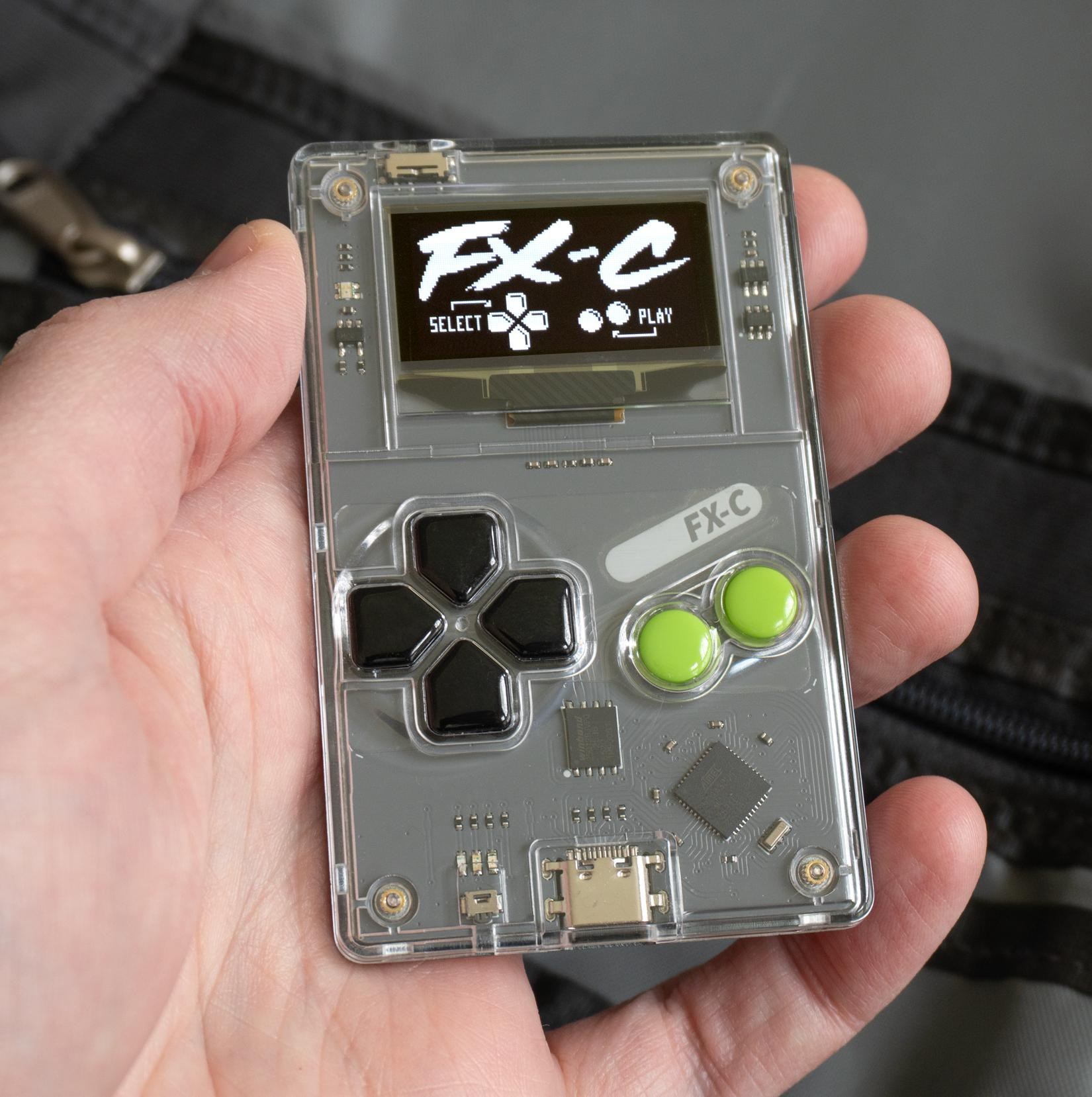
After over a decade of minor iterations, the Arduboy FX-C looks very much like the original. The controls are limited to six buttons, four of which function as a D-pad. They have a minimal amount of travel given the device is just 5mm thin, but a satisfying amount of click when pressed. The piezoelectric speaker is high pitched but more than loud enough, and its 1.3-inch, 1-bit OLED screen is bright enough to be playable outdoors.

While the 37-year-old original Game Boy could display four shades of greenish-gray, the Arduboy FX-C’s screen is monochromatic and limited to only white pixels. Developers have to rely on visual tricks like dithering or flickering to create grayscale graphics. Equally limiting is the FX-C’s ATmega32u4 processor that’s paired with just 2.5KB of RAM. Compared to other black-and-white handhelds like the Playdate, the Arduboy FX-C feels primitive but its limitations have forced game developers to get creative and experimental, which is a big part of this platform’s appeal.

My biggest frustration with the original Arduboy was its minimal storage that had me regularly connecting the device to my laptop when I wanted to play a different game. In 2020, Bates introduced the Arduboy FX with an extra flash chip on board that could hold 250 games. The FX-C inherits that chip, but a slightly larger version, bumping its included library of games to over 300, while also upgrading the device from microUSB to USB-C.
It’d be nice if the FX-C had a color screen, a proper D-pad, dedicated volume buttons, an improved sound chip, Wi-Fi, Bluetooth, and even a microSD card slot, but none of those upgrades really feel necessary. It’s a handheld that feels pared down to the absolute bare necessities for gaming, but it works.

A tiny switch on the top edge of the FX-C powers up the handheld but it can occasionally be a challenge if, like me, your fingernails are short. After a near instant boot up, you’re presented with a simple homescreen and menu system. The bundled games are sorted into several categories including Action, Adventure, Arcade, Runner, Puzzle, and Racing you cycle through by scrolling left and right. Games in each category are instead scrolled vertically by pressing up or down. It’s simple and easy to navigate, however I would like to see one additional category that lists all the games alphabetically.


All of the games that have been developed for the Arduboy are distributed for free, so you’re not going to find any classic 8-bit games you recognize like Super Mario Bros. or Castlevania that Nintendo is still making available on platforms like its Switch. But there are plenty of excellent doppelgängers that are similar enough to scratch a nostalgic itch while also being unique enough to keep lawyers at bay. Surprisingly, despite the FX-C’s limited processing power, there are far more than just side-scrollers and falling block puzzle games included. You’ll also find first-person shooters, dungeon crawlers, and racing games with excellent frame rates.

There’s a lot of fun to be had, but don’t expect games that will take you weeks to finish. The Arduboy FX-C is better suited for quick pick-up-and-play sessions when you’ve got a few minutes to kill.
Unfortunately, the feature that convinced me to buy a pair of FX-Cs isn’t quite ready. I haven’t been able to get multiplayer over USB to work, although some users on the Arduboy community forums have been successful. Bates says the feature is still in development. Arduboy multiplayer cleverly takes advantage of the extra conductors on modern USB cables to pass game data back and forth, as Bates explains in a forum post, but it requires a more expensive USB 3.0 or Thunderbolt cable to work. After testing several different USB 3.0 cables from Amazon, I’ve had no success. It’s a feature I know can work and I expect hiccups to be sorted out eventually, but if that’s your only reason for grabbing a pair of FX-Cs, I’d hold off for now.
The Arduboy FX-C is still a solid upgrade. The original was one of the last devices I had to keep microUSB cables around for, but the huge collection of bundled games sourced from the Arduboy development community is the real reason to snag one. I’ve barely tried 10 percent of them at this point, and while the quality varies, it’s hard to feel disappointed when you’re not actually paying for them. A console is only as good as its library of games, and over the past decade, the Arduboy has managed to cultivate a devoted community developing hundreds. If you go in with an open mind and don’t worry about what it’s missing, you’ll absolutely enjoy this handheld.
Photography by Andrew Liszewski / The Verge