







Bitcoin (BTC +1.16%) is the world’s largest cryptocurrency. In fact, its market capitalization of $1.5 trillion represents more than half the combined value of every crypto coin and token currently in circulation. However, Ark Investment Management, which is run by seasoned technology investor Cathie Wood, thinks Bitcoin could be heading for a $16 trillion valuation by 2030.
Based on Bitcoin’s circulating supply of over 20 million coins, Ark’s prediction would translate to a price-per-coin of almost $800,000, representing a whopping 930% upside from its price of $77,700 as I write this. But how realistic is that target?

Image source: Getty Images.
Ark points to six potential upside catalysts
Ark published its latest Bitcoin forecast in the 2026 edition of its annual “Big Ideas” report, which highlights areas where the firm has identified value in the technology industry. It provided six core reasons for its 2030 Bitcoin target as follows:
- Institutional investment: Ark thinks global fund managers could park up to 6.5% of their $200 trillion in managed assets in Bitcoin.
- Digital gold: Ark predicts Bitcoin could amass up to 60% of gold’s $31 trillion market cap, as investors seek a digital alternative to the shiny yellow metal.
- Emerging-market safe haven: Developing countries are prone to economic and political turmoil, so Ark believes many of their citizens will increasingly buy Bitcoin as a hedge.
- Nation-state treasury: Ark thinks global governments will eventually hold some Bitcoin in reserve, the same way they hold gold and other assets. The U.S. actually established a strategic Bitcoin reserve in 2025.
- Corporate treasury: Companies could also add Bitcoin to their balance sheets as a hedge against inflation and economic uncertainty because it’s often impractical for them to own physical gold. Elon Musk’s SpaceX is one company using this strategy already.
- Bitcoin on-chain financial services: This describes peer-to-peer transactions completed exclusively through Bitcoin’s blockchain, bypassing traditional banks and payment systems.
The 2026 edition of the “Big Ideas” 2030 Bitcoin forecast came with two key changes compared to the 2025 version. First, Ark increased the size of the digital gold opportunity because the shiny yellow metal surged in value last year.
Second, Ark reduced the size of the emerging-market safe-haven opportunity because alternatives like stablecoins are experiencing rapid adoption. Stablecoins are usually priced in U.S. dollars and experience practically zero volatility, which makes them attractive to citizens in developing countries where economic instability is prevalent.
Ark’s modeling suggests the digital gold catalyst is expected to contribute the most value to Bitcoin by far. But there might be a flaw in the firm’s thesis because when gold surged higher by 64% in 2025, Bitcoin actually ended the year with a 5% decline.
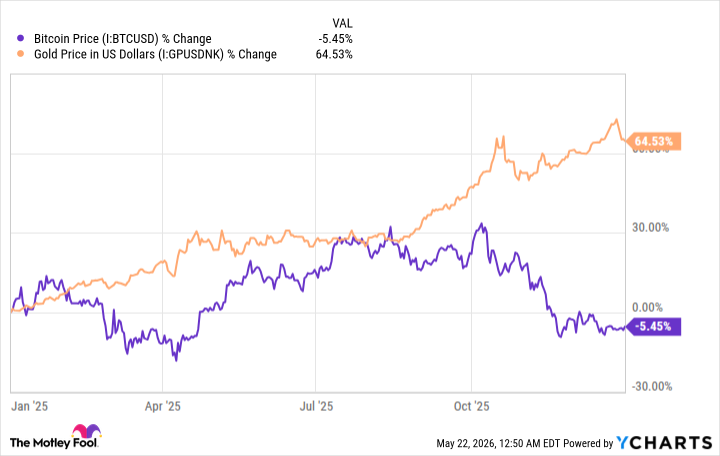
Bitcoin Price data by YCharts.
In other words, in the face of issues like soaring U.S. government spending and heightened economic uncertainty because of the Trump administration’s widespread tariffs, investors unequivocally chose gold as their preferred safe-haven asset and neglected Bitcoin.
Ark’s 2030 forecast might be a little unrealistic
While a 930% return over the next four years might sound very attractive to investors, a $16 trillion market cap would place Bitcoin in some very rarified air. For some perspective, it would be more than three times as valuable as the world’s largest company, Nvidia, which is currently worth $5.3 trillion.
Moreover, U.S. gross domestic product (GDP) was $30.7 trillion last year, and I’m not sure it’s realistic for Bitcoin’s value to match half of the U.S. economy’s annual output.

Today’s Change
(1.16%) $880.59
Current Price
$76818.00
Key Data Points
Market Cap
$1.5T
Day’s Range
$74344.00 – $77084.00
52wk Range
$60255.56 – $126079.89
Volume
33.5B
Unfortunately, there is actually some evidence that Bitcoin demand is starting to slow. According to investment bank JPMorgan Chase, investors are on track to deploy around $44 billion in fresh capital into digital assets this year, which would be one-third of the amount they deployed in 2025.
Plus, the bank says demand from retail and institutional investors was extremely small, or potentially even negative in the first quarter of 2026, with most of the capital inflows coming from a single buyer: Michael Saylor’s Bitcoin treasury company, Strategy. That isn’t a recipe for sustainable upside, and it suggests Ark’s prediction that global fund managers will eventually park up to 6.5% of their managed assets in Bitcoin might be too optimistic.
Therefore, although there might be some room for upside in Bitcoin from here, I would assign a very low probability to Ark’s target of $800,000 per coin.