








Gold, often called the barbarous metal, has been used as currency for thousands of years. Today, fiat currency (paper money) has replaced gold and other precious metals. However, gold still retains its appeal for those seeking diversification and a store of wealth.
Exchange-traded funds (ETFs) SPDR Gold Shares (GLD 0.76%) and iShares Gold Trust (IAU 0.73%) are seeking to capitalize on that investor demand. Here’s why this is valuable and why one of these two ETFs is probably a better choice.

Image source: Getty Images.
Gold is hard to deal with
If you want to own gold, the most logical option is to buy gold bullion at a coin store. You can even buy gold coins directly from the U.S. Government. There are some problems with this approach. First, you aren’t going to pay the spot price of gold. There are transaction fees, since the dealer and U.S. Mint need to make some money from the sale. In the case of the U.S. Mint, they need to be paid for physically producing the coins and for selling them. Coin dealers need to make a living, and the only way that can happen is if they charge you more than they pay, whether that be a markup or a sales fee.
Second, and don’t overlook this issue, you’ll need to do something with your gold coin once you have it. If you only have a few coins, that may not be a problem. If you have a large enough hoard of gold, you’ll probably need to pay for special storage. That could be a safe in your own home or a safety deposit box. And, either way, you’ll need to worry about your physical gold being stolen.

Today’s Change
(-0.76%) $-3.17
Current Price
$413.82
Key Data Points
Day’s Range
$412.00 – $415.68
52wk Range
$299.89 – $509.70
Volume
5.5M
This is why SPDR Gold Shares and iShares Gold Trust exist. They are exchange-traded funds that own physical gold. Given their portfolios, the prices of the two ETFs track the barbarous metal over time. They make adding gold to your portfolio for diversification purposes much simpler. But there are problems to consider before you jump aboard.
You don’t have the gold, and you’re still paying fees
When you own gold bullion, you can use the gold in a worst-case scenario, such as the collapse of the global banking system. While SPDR Gold Shares owned more than 32.5 million ounces of gold at the end of fiscal 2025, and iShares Gold Trust owned nearly 15.5 million ounces as of May 18, you just own shares in an ETF. For most investors, this won’t matter, since they are likely buying gold for diversification purposes. However, if you want physical gold, neither one of the ETFs will work for you.

Today’s Change
(-0.73%) $-0.62
Current Price
$84.81
Key Data Points
Day’s Range
$84.47 – $85.17
52wk Range
$61.37 – $104.40
Volume
3.2M
Avg Vol
9.3M
And, just as important, buying these two ETFs, even if you don’t pay for the trade, won’t let you avoid paying fees. Like all ETFs, SPDR Gold Shares and iShares Gold Trust come with expense ratios. SPDR Gold Shares’ expense ratio is 0.40%, and iShares Gold Trust’s expense ratio is 0.25%. On an absolute basis, those two expense ratios aren’t huge, and they are pretty close to each other. On a percentage basis, however, they are dramatically different.
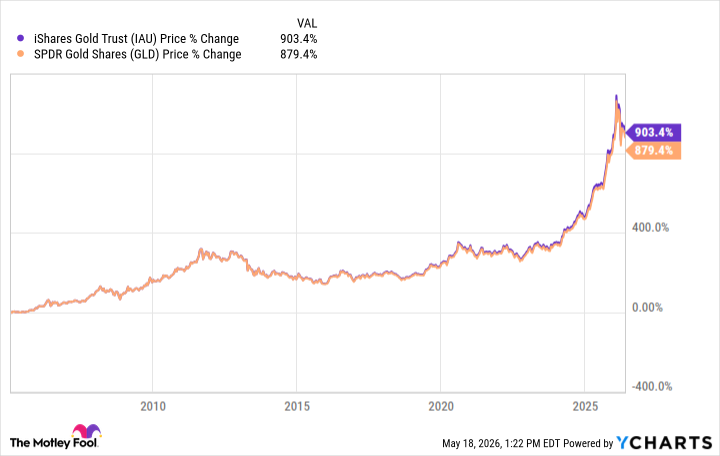
SPDR Gold Shares was created in Nov. 2004, and iShares Gold Trust was created in Jan. 2005. So they have both been around for roughly the same amount of time. The truth is, they perform very similarly in the short term, but over the long term, the expense ratio difference has added up. Notably, over the period both ETFs have existed, SPDR Gold Shares has increased in value by just under 880%, while iShares Gold Trust has increased by a little under 904%. For most investors, going with the lower-cost gold ETF is the better choice, since they do the same thing investment-wise.
Not a big mistake, but every little bit helps
If you bought SPDR Gold Shares, you wouldn’t have made a particularly big mistake. It’s more expensive to own, and that has, over the long term, impacted its performance relative to iShares Gold Trust, which has a lower expense ratio. That said, if you have the choice, iShares Gold Trust and its lower costs are the clear winner in this gold ETF match-up.