







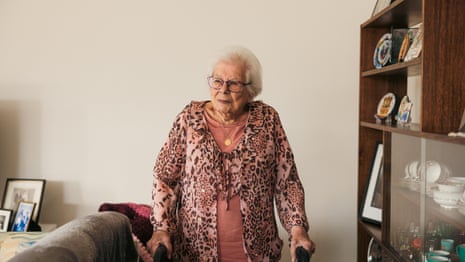
At the grand, biblical age of 102, Sonja Ibermann Cowan has zero interest in wasting her time. There are delicious great-grandbabies to be serenaded, uproarious meals to share with her three beloved daughters, and meaningful celebrations of the high holidays to mark with her Melbourne rabbi, who makes house calls. Five years ago, she decided to invest some of that precious time in what became a friendship with me, across the world in Berlin, her birthplace.
The boredom of the pandemic certainly played a part. Cooped up at home under much stricter Covid-19 restrictions than we had in Germany – Sonja joked about being “eingesperrt” (locked up) – she and her extended close-knit family started turning their attention to the past. Her grandson Benjamin Preiss, a journalist at the Australian newspaper The Age, embarked on an ambitious research project to uncover the mysteries of Sonja’s life and her mother’s and sister’s murders in the Holocaust.
It was as a result of this that I got a remarkable message in July 2020 from Benjamin. He had read a piece I’d written three years earlier that happened to mention his great-aunt Lotte and his great-grandmother Taube. Benjamin told me his grandmother Sonja, Lotte’s younger sister, was still alive, thriving even, and wanted to talk. I was thunderstruck.
A few weeks earlier, Benjamin’s mother Sandra had come across that essay of mine, written just after Donald Trump’s first inauguration, about the landscape of historical memory in the German capital on my walk to work. Preserved bullet holes from the Battle of Berlin on Museum Island; tank shell scars on buildings at Humboldt University; and memorials large and small to victims of the Nazi terror … I wanted to explore whether, as several postwar German generations have claimed, keeping the darkest chapters of your national history alive on your doorstep helped inoculate citizens today against extremism.
The most impactful of these memorials are the Stolpersteine (stumbling stones): small brass plaques embedded in the pavement in front of the last-known homes of Holocaust victims. Each includes a stark inscription with a name, date of birth, deportation date and, if known, date and place of death. As a reporter, I’ve written many times about the stumbling stones, the life’s work of artist Gunter Demnig, and often described as the world’s biggest grassroots remembrance project. There are now more than 100,000 of the plaques laid across 31 European countries, dedicated to victims who, overwhelmingly, have no marked grave. The Stolpersteine bring the incomprehensible scope of the Nazi slaughter down to a human scale, as passersby quite literally bow before them to consider a single person’s fate. Two lie in front of my building in central Berlin. They are dedicated to Sonja’s mother Taube Ibermann, known as Toni, and Toni’s eldest daughter Lotte. My German husband Hilmar and I have for years made a point of polishing them, a small gesture honouring these strangers who during the second world war would have been our neighbours. With Benjamin’s message, the stones suddenly came alive.
My first conversation with Sonja came in September 2020, on a lockdown Zoom call unlike any other. Via Sonja’s eldest daughter Lorraine, who lives with her, we arranged to speak on a Sunday before Sonja’s bedtime in Melbourne and just after breakfast in Berlin. Sandra and Benjamin joined the conversation, both out of an instinct to protect her, they told me later, and in the hope that she might open up to a stranger calling from her old home town about still-hazy aspects of her childhood and eventual journey to the UK as a teenager.
Sonja appeared on screen with a bright smile and a dab of rose-coloured lipstick: self-possessed, focused and looking at least two decades younger than her 97 years. Her hearing and memory were clear as day, and she had a cheeky, suffer-no-fools humour that marked her out instantly as a born Berliner. As we got to talking, she chuckled at my pronunciation of the German tongue-twister street name of Stallschreiberstraße (you try it) where she went to school for a time. And she drily noted: “I haven’t got much time left. So I live from day to day, especially now, while I’m eingesperrt,” to protect her health. “No dancing!” she joked. Her singular German-Scottish accent when speaking English, with just a touch of Australian twang, traced her tortuous life path.
During our chats throughout the pandemic and beyond, Sonja and I eased into a relaxed rapport. She recounted her extraordinary journey, while I gently probed, conscious of not wanting to push too hard for details. We agreed she would let me know if there was anything too painful to discuss. “You ask the right questions,” she told me during our first conversation. “Thank you for being interested in it.” We’re always joined by some of her children and grandchildren, who affectionately call her Bubbe – Yiddish for granny. They sit in, rapt, to hear her stories of fear, flight, heartbreak and surprising joy amid all the crushing sorrow.
Sonja was born in Berlin in 1923, one of three daughters of observant Jews from Poland, Leib “Leo” Ibermann and Toni Ibermann née Rosler. Her parents spoke Yiddish at home and their German bore a thick eastern European accent, marking them as outsiders.
Before Sonja’s younger sister Ursel was born, Leo, a salesman, died of a heart attack aged just 29, leaving pregnant Toni to support the young family as a seamstress. “I didn’t have a very good life as a child,” Sonja said in her matter-of-fact tone.
Wealthier relatives across town helped when they could, allowing Sonja and her family to use their tub with hot running water instead of the public baths. Once, an uncle gave them a gramophone – a delight to music-loving Sonja – but because it was incompatible with the electricity in their part of town, she had to spin the records herself, with a finger, to get them to play.
There is an extraordinary photo of the three young daughters wearing sailor suits – fashionable dress for children at the time – sewn by their mother. They’re lined up in a row by height – like organ pipes, as the German expression goes. While middle child Sonja clutches Lotte’s hand, her big sister looks into the camera, her dark eyes fixed in a watchful expression.
Adolf Hitler came to power when Sonja was nine years old; the Nazis’ rise would soon have a direct impact on her young life. Within a few years, the public school she enjoyed summarily expelled her and other Jewish children. Her outrage is still palpable more than eight decades on, but Sonja, as so often in her life, just got on with it.
Newly enrolled at a Jewish school in the grounds of the beautiful Rykestraße synagogue in the Prenzlauer Berg quarter, she found a new community of children and teachers. Recently, we talked about some physical therapy she had been assigned after a hospital stint, and she said it reminded her of the “beugen und strecken” (bending and stretching) she had learned all those years before in Berlin PE classes, chuckling as she put herself through her paces for us on the webcam.
Toni was rarely able to pick Sonja up at the school gates, often returning home from work hours after dark, so Lotte, who was only just over a year older than Sonja, had to take on maternal responsibilities. Sonja recalls Lotte waiting for her one day when school let out with a coconut in hand for them to share its milk through a straw on the way home. “She had lovely big eyes, a nice smile and she always wore earrings, since she was a baby,” Sonja said.
But their visibility as Jews walking home from the synagogue grounds soon felt risky. Bands of Hitler Youth, newly emboldened, roamed the streets bullying young and old. “When we saw the Nazis marching, we used to hide behind the big doors of buildings,” Sonja said. “We didn’t want to say, ‘Heil Hitler.’”
The Kristallnacht pogrom on 9-10 November 1938 saw the noose tighten around Germany’s Jews. Hundreds of men were rounded up and sent to concentration camps, and Jewish-owned businesses in the neighbourhood were sacked and vandalised. I found archive photos, collected by the Centrum Judaicum foundation, showing recognisable storefronts in our neighbourhood defaced with antisemitic graffiti.
Painfully aware that Nazi Germany was no longer safe, Toni had already hatched a plan to save her family. By the time of Kristallnacht, she had sent Sonja away to an agricultural training camp in rural Steckelsdorf, founded by the Orthodox Jewish youth organisation Bachad, short in Hebrew for the Alliance of Religious Pioneers. A Berlin industrialist donated a hunting lodge and its abundant nursery in the countryside to the Jewish community, forming the heart of the camp.
Even as a city kid, Sonja took to her farming classes in Steckelsdorf, where she found another tribe of friends under the big skies of the Brandenburg region. “I loved it. We were always climbing trees to pick the cherries,” she said. One day on a country road, an SS officer on a motorcycle took her for a member of the BDM, the girls’ wing of the Hitler Youth, and offered her a lift. True to type, Sonja thought briefly of the long walk ahead, then hopped on the back and held on tight.
By 1938, the international community was aware of the Nazis’ crackdown on Jews. Jewish organisations in Europe and the US attempted to rescue at least the youngest by appealing to governments to take in child refugees on temporary visas. About 10,000 were brought to the UK by rail and boat as part of the Kindertransport programme, but they had to leave their parents and other adult relatives behind to an uncertain fate.
Toni’s youngest daughter Ursel had lived in an orphanage on nearby Auguststraße for most of her childhood because her mother could not afford to keep her at home, though she visited the family often. In May 1939, the spirited Ursel escaped Germany on a train for Britain. Three months later, Sonja received the news in Steckelsdorf that she was on the Jewish community’s “list of the endangered” in Brandenburg, along with three other trainees, and had to pack up her things in a rush.
On 10 August 1939, Sonja followed on the 28th Kindertransport to England. She was 16, the maximum age of eligibility. Today, she dismisses any suggestion that embarking for a new life in an unknown country with a foreign language required bravery. “I am a person who accepts anything and everything,” she told me, squaring her shoulders. “I take everything in my stride.”
Sonja and Toni’s goodbye on a warm, overcast day at Friedrichstraße station was deceptively businesslike: a firm handshake from her mother with a pledge that the family would reunite in Palestine. It was the last time they saw each other.
Letters from 1939 and 1940 that Sonja’s family miraculously recovered decades later bear witness to the real anguish of their separation, exposing Toni’s composure that day on the platform as a brave face for her daughter’s benefit. In almost every correspondence with Sonja and Ursel, Toni pleaded for news about their life in Britain: “Please write me everything in detail.” She wrote to Sonja: “Many warm greetings and kisses from your mother who loves you.”
While the younger girls were able to escape to Britain, their sister Lotte had narrowly aged out of the Kindertransport programme and stayed behind with Toni. Around the time of Sonja’s departure, they moved into the 19th-century building in the Prenzlauer Berg district where I, an American transplant, now live. A visit to their former flat revealed the original panel doors and wooden floorboards were still intact, and I imagined Toni and Lotte anxiously moving through the rooms, waiting for the Gestapo to appear outside the large, street-side windows.
By 1941, Toni and Lotte were forced to transfer to a Judenhaus, a Nazi-designated building where Jews were kept in often overcrowded conditions to free up accommodation for the “Aryan” population, on today’s Torstraße. From there, records indicate they were deported together to Łódź on 27 October 1941. Łódź had the largest Jewish ghetto in occupied Poland outside Warsaw. Sonja learned only decades later, with help from Berlin’s Jewish Museum, that this was where the Nazis killed her mother and sister.
Sonja eventually arrived in north Wales, speaking “not one word of English”. She managed to file an application so she could reunite with Ursel at an institution for Jewish children in Scotland, the Whittingehame farm school, where they spent about a year together. Sonja described the journey there as terrifying. “I don’t know how I managed to travel there on my own,” she said. “I had no idea where I was.” The person she had been told would pick her up at the station was nowhere to be found. Eventually, a man came by and offered to help, saying his sister spoke some German. She got in the car with him. “I wouldn’t do it now,” she said wryly. “Anything could have happened to me.”
The school soon told her she needed to earn her keep as a domestic servant in local households, work Sonja hated. She bided her time until she turned 18, when she could join the British army. “That’s where I learned English, actually,” she said, describing a sudden new feeling of belonging. For the rest of the war she worked in military storerooms, first in Glasgow, then in Stirling and Basingstoke.
When the war ended, Ursel married in London. Many years later, she emigrated to the US; she died in Arizona in 1999.
After her job wound down, Sonja returned to Glasgow to live with a Jewish family who called her the “little refugee girl”. One day, a young man named Ralph Cohen, who had also served in the British army, came by to introduce himself, having heard about the charming new arrival. Decades on, Sonja still delights in the cheeky romance of their first encounter. She answered the door in her dressing gown and told him she had been about to wash her hair. He replied with a rakish offer: “I’ll do it for you – I’m a hairdresser.” They were married within the year.
Like Toni, Sonja went on to have three daughters. Facing antisemitism in postwar Scotland, the family changed their name to Cowan. Ralph, remembered affectionately by his family as something of a dreamer, eventually tired of Glasgow’s relentlessly damp weather and stunted job opportunities, and in 1962 proposed a move to the other side of the globe: Australia. Sonja found work at the Red Tulip chocolate factory in the Prahran suburb of Melbourne. She and Ralph enjoyed another five decades together, until his death in 2013.
As of 2023, Australia had the highest per capita population of Holocaust survivors outside Israel, with an estimated 2,500 still living. Despite the presence of so many people who shared a similar fate, Sonja told me there was little talk of the Nazis in Melbourne. “I get upset when I see reports on television about concentration camps, that sort of thing,” Sonja said. “It still hurts.”
After December’s antisemitic massacre in Sydney’s Bondi beach, Sonja told me it had triggered a long-buried memory of a Hanukah celebration in Berlin from her childhood almost a century before. “All of a sudden, I remembered a song from when I was in kindergarten,” she said. “I might have been four or five. I was on the stage wanting to sing that song. Can you believe I remembered the words? It’s a miracle.”
With her remarkable stamina, Sonja looks forward to our conversations as a chance to reminisce about happier times. She likes to launch into old German songs from her childhood, sending Hilmar scrambling through his phone to find the words so we can sing along. One of her favourites is Meine Oma Fährt im Hühnerstall Motorrad (My Granny Rides Her Motorcycle in the Chicken Coop), a banger for kids from the 1930s. Despite all Germany took from Sonja, it astonishes me how she still embraces the culture she was steeped in growing up.
Sonja has been back to Berlin twice since the war, unfortunately long before we met online. Once was with Ralph when she turned 70, on the invitation of the city government. “I didn’t enjoy that visit,” she told me. “I didn’t feel at home – it just didn’t feel right.” She recalled the official programme included attending the musical Cabaret, about two expats experiencing the last hedonistic nights of the Weimar republic as the Nazis are on the rise – a choice she found insensitive. But she returned with her youngest daughter Hilary, just before her 90th birthday, after the Stolpersteine were laid, when she set her own itinerary. “I visited all the places I remembered,” she said, “including the cemetery where my father is buried,” in the Weißensee district. When I asked her if she ever wrestled with the feelings of guilt that plague other Holocaust survivors, she paused. “I thought about it and I say, I’m lucky. I do not feel guilty, I’m lucky.”
Sonja’s family are ardently devoted to their sunny matriarch. Benjamin is now working on an extended creative nonfiction project as part of a master’s degree, focusing on her experiences and how they have shaped the family’s identity. As well as conducting hours of interviews with his grandmother, he has pored over deportation lists, family letters, photographs and reports produced by Nazi officers. He uncovered identity cards that he said revealed Toni and Lotte were forced to work for German electronics company Siemens in Berlin before they were deported to Łódź.
Here in Berlin, I try to carry forward the best of an expansive culture of historical remembrance and its humanist spirit. And I keep polishing the Stolpersteine, sending pictures of them catching the light to Sonja. Lorraine sweetly thanks me for “taking care of our girls”. Hilmar occasionally hangs a sticker with a QR code next to the stones with links to my essays for anyone interested, and last year he got in touch with teachers at neighbourhood schools about our special connection to living memory.
And so it came about that 10th graders from the local John Lennon Gymnasium school – the same age as Sonja was when she fled on the Kindertransport – got to interview her about her life under the Nazis. Afterwards, using her voice note answers to their questions, the pupils scripted and edited the resulting project themselves – a podcast now available in German, French and English.
As for me, if all goes well, I will acquire German citizenship in the coming months. I don’t take the step lightly, knowing that it carries responsibilities for an ever-present past. With extremism on the rise in both my birthplace and my adopted homeland, I think an honest reckoning with history is essential for the centre to have a chance of holding.
The renowned researcher of German cultural memory Aleida Assmann wrote about our unlikely connection with Sonja in her final book with her late husband, Jan Assmann: Gemeinsinn, meaning community spirit. “Remembrance at your front door can bring about unexpected blossoms, jumping from the brass plaque into the digital world and around the globe … If that isn’t a remembrance miracle!” Assmann argues that in only a decade or two, when all the Holocaust survivors are gone, we will have to find new ways of keeping their stories alive.
One day not long ago, I opened our apartment door to find a fresh bottle of brass polish on our mat with a newspaper clipping about the Stolpersteine – a gift from our elderly German landlords. “For Taube and Lotte,” they wrote.
And when we’re no longer living in our building, I think there’s a good chance that some of those young podcasters will keep looking after the stumbling stones, allowing them to keep speaking.


