








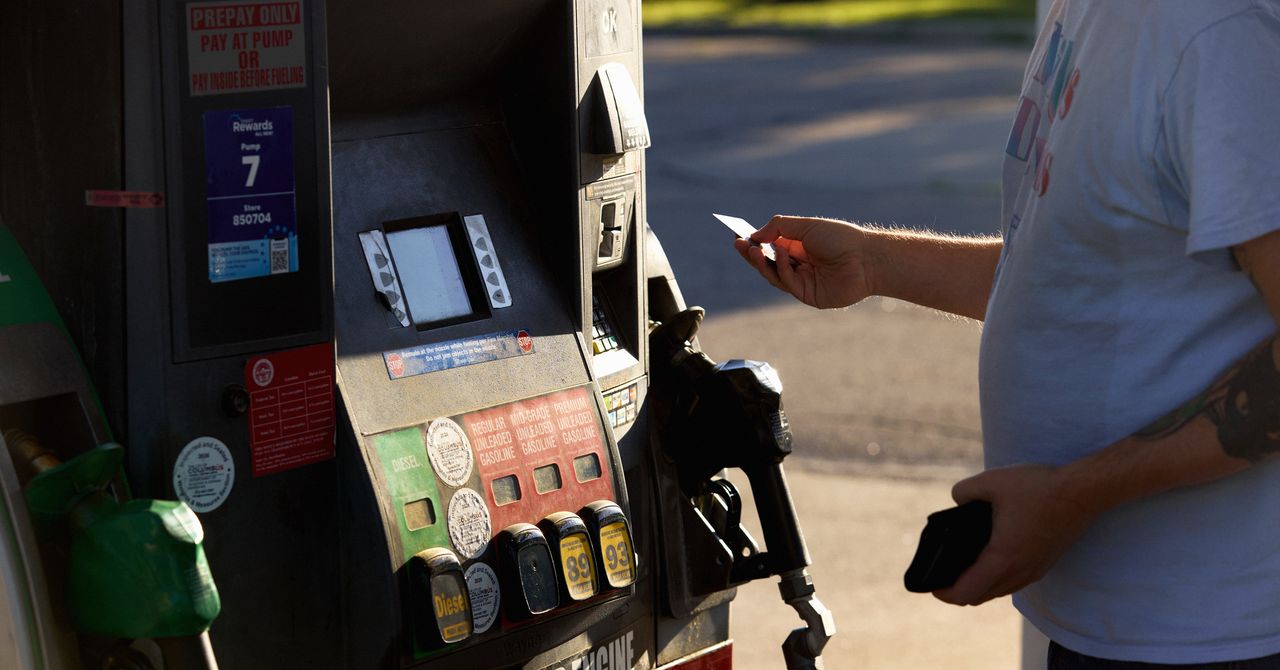
As gas prices stay stubbornly high across the country, President Donald Trump mused this week about suspending the fuel tax US consumers pay. The idea is also picking up steam in Congress, with Democratic and Republican lawmakers pushing for a gas tax holiday.
But experts tell WIRED that it’s unlikely that any rollback—even temporary—of the fee will save consumers much as the unofficial start to summer travel season nears.
“It’s unlikely that oil prices, gasoline prices, diesel prices are going to fall back to where they were in February any time in the next couple months,” says Clark Williams-Derry, an analyst at the Institute for Energy Economics and Financial Analysis.
The Strait of Hormuz, one of the world’s most crucial shipping routes and a chokepoint for both oil and gas supply and production, has remained effectively closed since early March, when the US and Israel first launched strikes against Iran.
The average price of gasoline across the country was $4.53 per gallon as of Thursday, up from $4.12 a month ago, and $3.18 last year, according to AAA. That includes the federal gas tax, which is a little over 18 cents a gallon. Trump can’t suspend the gas tax on his own—it would take an act of Congress. (The White House didn’t immediately respond to a request for comment.) The tax, which was created in 1932, has never been suspended. But politicians from both sides of the aisle have put forward a variety of bills this year that would temporarily lift the federal tax.
Even if the tax is suspended for the summer, drivers wouldn’t necessarily see much in the way of savings. Prices at the pump are decided by a number of different factors, from refining costs to the costs to operate gas stations. The price of oil has also fluctuated wildly, with Brent crude—a key benchmark—rising to an all-time high of $144 per barrel on the night of April 7, when Trump and the Iranian government brokered a 2-week ceasefire. It currently sits around $105 a barrel, still much higher than the average of $69 in 2025.
And inflation driven by high fuel prices and a shortage in commodities that rely on oil as a key input, like fertilizer, around the world is also making life more expensive for Americans. In April, the consumer price index—used to measure inflation—was up 3.8 percent year over year. With the costs of everything from food and rent to airfare ticking up, an 18 cent savings doesn’t add up to much over the long run.
“When you take away the retail gas tax, it’s not going to have a dramatic effect [for consumers],” says Tyson Slocum, the director of the energy program at the progressive think tank Public Citizen. “But what would be dramatic is loss in federal revenues.”
The federal gas tax funds the Highway Trust Fund, which was formed to support highway maintenance and mass transit projects. That fund was already facing severe insolvency issues even before proposals to lift the federal gas tax. Williams-Derry points out that many of the roads in the US are “literally crumbling:” Nearly 40% of the country’s highways and roadways are in need of repair, a 2025 survey found. The already-low taxes are a big driver of poor infrastructure, he says.
Cutting off revenue, even temporarily, would only exacerbate the problem. There’s also a possibility that a temporary break could be extended indefinitely given the political risks of reinstating it, particularly as midterms near.
“The loss of federal revenues available to ensure that our transportation infrastructure remains sound, it’s just not a good deal for consumers,” Slocum says.
Closing the Strait of Hormuz has cut a massive amount of global oil supply suddenly off from the market in what is widely-agreed upon to be one of the worst energy crises in history. Even if the Strait of Hormuz immediately opens up tomorrow, the effects of the new supply could take a while to reach consumers—likely a month or more as tankers travel to customers and production facilities start back up again.
“An oil tanker moves as fast as a bicycle,” says Williams-Derry. “It’s a significant trip.”