









The Dow Jones Industrial Average (^DJI +0.02%), S&P 500 (^GSPC +0.84%), and Nasdaq Composite (^IXIC +1.71%) rising under a sitting president is nothing new. The Dow or S&P 500 have gained in 26 of the last 33 presidential terms, dating back to 1896.
But in terms of annualized returns, Wall Street’s major stock indexes have gained more under President Donald Trump than under most other presidents. During his first, non-consecutive term, the Dow, S&P 500, and Nasdaq Composite rallied 57%, 70%, and 142%, respectively.
Since the president’s second term began on Jan. 20, 2025, investors have witnessed an encore performance. All three indexes are up by double digits, with the evolution of artificial intelligence (AI) and record S&P 500 share buybacks powering the Trump bull market.
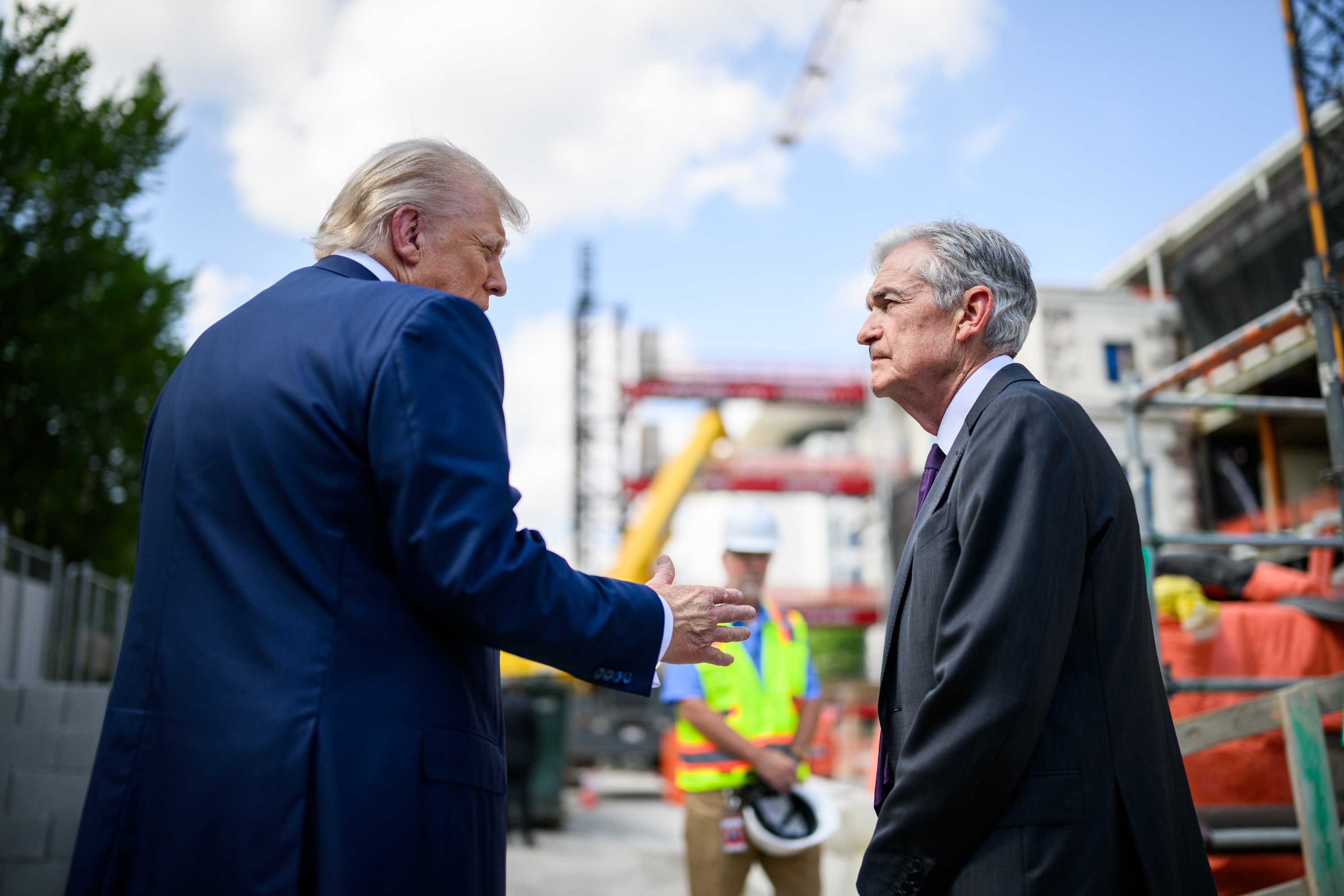
Jerome Powell’s final day as Fed chair is May 15. Image source: Official White House Photo by Daniel Torok.
However, the stock market may not be as healthy as Wall Street’s major indexes portray it to be. Although several headwinds point to stocks tumbling, including historically expensive valuations, Trump’s decision to nominate Kevin Warsh to succeed outgoing Fed Chair Jerome Powell may be the spark that upends the bull market.
Kevin Warsh wants to reshape the central bank — and Wall Street might pay the price
Jerome Powell’s final day as Federal Reserve chair is May 15. Assuming Warsh receives the requisite majority vote from the U.S. Senate before May 15, he’ll be confirmed as the successor to Powell and become the 17th head of the Fed.
On the one hand, Wall Street should be pleased that Warsh brings experience to the position. He previously served on the Board of Governors of the Federal Reserve from Feb. 26, 2006, to March 31, 2011, and was a voting member of the Federal Open Market Committee (FOMC). The FOMC is the 12-person voting body that sets the nation’s monetary policy. Warsh was one of the key players who helped navigate the U.S. economy through the financial crisis.
But the presumed new Fed chief’s plans to reshape the central bank conflict with the catalysts needed to send Wall Street’s major stock indexes higher.
Kevin Warsh Nomination: one reason why market players are interpreting it as a hawkish pick- I agree-is because of his views on the need for a radical balance sheet reduction.
The $31 trillion-dollar American economy demands liquidity & financing needs that are larger than what… pic.twitter.com/zYunGAItV8
— Joseph Brusuelas (@joebrusuelas) January 30, 2026
For example, Trump’s Fed chair nominee hasn’t minced words about his distaste for the central bank’s bloated balance sheet. Between August 2008 and March 2022, the total assets held by the Federal Reserve grew roughly tenfold to almost $9 trillion. Even after a quantitative tightening cycle, the central bank still holds $6.7 trillion in assets (mostly long-term U.S. Treasury bonds and mortgage-backed securities).
The worry for investors is that bond prices and yields are inversely related. If Warsh aims to sell trillions of dollars in long-term Treasuries, it would likely drive down bond prices and notably raise yields, thereby increasing borrowing costs. The last thing a historically expensive stock market needs is higher lending costs that could stymie the AI data center build-out.
Furthermore, Kevin Warsh’s FOMC voting record during the financial crisis raises concerns. Although members of the FOMC aim to uphold the dual mandate of price stability and maximum employment, Warsh was overwhelmingly focused on suppressing inflation during the Great Recession, even as the unemployment rate soared.
If the past is any indication of the future, Trump’s Fed chair nominee is likely to advocate for higher interest rates over longer periods to suppress inflation. While this could be positive for the stock market’s long-term outlook, the prospect of higher interest rates amid the second-priciest stock market in history is a potential recipe for disaster.

Image source: Getty Images.
Warsh is set to inherit a historically fractured FOMC
But Kevin Warsh’s monetary policy approach is only part of the reason why the Dow Jones Industrial Average, S&P 500, and Nasdaq Composite may plummet under his leadership. In addition to the prospect of higher interest rates, the presumed incoming Fed chair will inherit a historically fractured FOMC.
You might not realize it, but over the last 48 years, no Fed chair has had fewer dissents than Jerome Powell. During his tenure as the head of the Fed, there were 31 total dissents, equating to an average of 0.46 per meeting. That’s slightly lower than former Fed Chair Alan Greenspan, and notably below Powell’s predecessor, Janet Yellen.
However, the final year of Powell’s tenure as Fed chair was a marked difference from the previous seven. The final seven FOMC meetings he presided over yielded at least one dissenting opinion.
Fed Chair Jerome Powell concluded his final FOMC as Chair.
Rates were held steady, but with 4 dissents. The most since Oct 1992.
Miran dissented in favor of easing, while Hammack, Kashkari, and Logan opposed an easing bias.
Total dissents during Powell’s term: 31. pic.twitter.com/47UBgfppZP
— Bluekurtic Market Insights (@Bluekurtic) April 29, 2026
In the October and December meetings, we witnessed dissents in opposite policy directions for only the second and third time since 1990! Whereas Stephen Miran favored a more aggressive 50-basis-point reduction in the federal funds rate at both meetings, at least one voting member opposed any cut.
Additionally, Powell’s final meeting on April 29 featured four dissents — the highest number since 1992.
Professional and everyday investors often view America’s foremost financial institution as the stock market’s bedrock. Although it’s perfectly normal for the FOMC to be behind the curve when it’s using backward-looking economic data to adjust the nation’s monetary policy, investors expect all voting members to be on the same page.
The FOMC that Kevin Warsh will be heading might be the most divided we’ve ever witnessed. Aside from the potential for monetary policy inefficiencies arising from this division, a fractured FOMC threatens to diminish the central bank’s credibility. If the Fed’s credibility is irreparably damaged under Warsh’s leadership, a key pillar responsible for propping up an expensive stock market will no longer be there.
Ultimately, President Trump’s pick to lead the Fed may be what ends the bull market that has flourished during his tenure.