





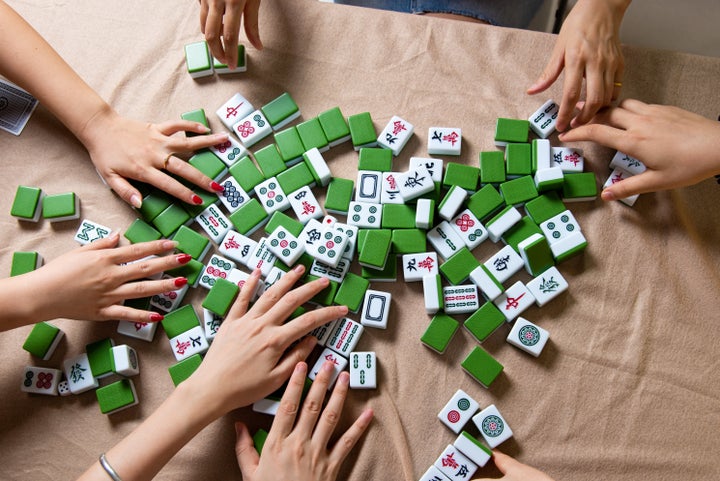
Designer mahjong sets. A mahjong-themed Hallmark movie. Scores of mahjong clubs popping up in major cities. A century after its first boom in the United States, the nearly 200-year-old tile game with origins in China is having another moment stateside.
This resurgence has not come without criticism. As the game grows in popularity among younger, often non-Asian players, many in the AAPI community have raised concerns about cultural erasure and commercialization.
“It’s important to remember that mahjong isn’t ‘new,’” Han Ren, a psychologist and author of “The Hyphenated Life: Bridging the In-Between Spaces of Intersectional Identities,” told HuffPost. “There is a deep, rich, longstanding and powerful cultural history around mahjong in China, Taiwan, Singapore, Malaysia and other Asian countries. This is not a new fad or game.”
Indeed, many credit the hit 2018 rom-com “Crazy Rich Asians” ― set in Singapore ― with boosting the popularity of the game. In one notable scene, the protagonist squares off against her love interest’s mother in a symbolism-ridden sequence of gameplay.
More recently, critics have pointed to a lack of Asian representation in projects like Hallmark’s upcoming “All’s Fair in Love and Mahjong,” as well as the rise of “modernized” sets that strip away traditional symbols and meaning in favor of aesthetic trends.
“We need to respect the culture and history that we are borrowing from when we play mahjong in the U.S. with mostly non-Asians and remember to pay tribute to longstanding traditions,” Ren noted.
Mahjong’s rich cultural history is part of what makes the game so meaningful for many players. On the surface, it’s a game of tiles and strategy, but beneath the rhythmic clacking is a surprisingly powerful tool for connection and emotional well-being.
“What makes mahjong powerful is that it doesn’t feel like ‘mental health care,’” said clinical psychologist Jenny Yip. “Mental health isn’t just about reducing distress. It’s about building connection, structure and engagement into everyday life. People may not seek therapy. However, they’ll show up to play.”
In this way, the game offers far more than nostalgia or entertainment.
Social Connection, Sense Of Belonging And Community
“Mahjong requires four players, so you literally can’t play alone,” said Dr. Sue Varma, author of “Practical Optimism” and a clinical assistant professor of psychiatry at New York University Grossman School of Medicine. “That built-in accountability ― ‘the table needs me’ ― gets people out of the house and into community on a consistent basis, which is one of the strongest predictors of long-term mental and physical health.”
Regular mahjong games give people a reason to gather and foster relationships with one another.
“This is especially meaningful for older folks who are retired, empty nesters or people who are not good at asking for emotional support,” said May Han, a licensed marriage and family therapist at Spark Relational Counseling. “Studies have shown that isolation and loneliness increase one’s stress level and likelihood of experiencing other mental health issues, such as depression and anxiety.”

Stefan Tomic via Getty Images
In-person social rituals like mahjong can help protect against these risks, especially when done consistently.
“The structure of daily life can be isolating ― it is easy for weeks to go by without seeing friends and loved ones,” said licensed marriage and family therapist Caitlyn Oscarson.
Joining a mahjong club counteracts this tendency and builds a sense of belonging. Licensed professional counselor supervisor Barbara To noted that there’s been a surge in popularity among mothers in particular.
“Many times, moms can get lost in other roles such as house manager, chef, party planner and chauffeur,” she said. “The opportunity to play mahjong with others can sound very appealing as oftentimes the role of friend is not prioritized.”
A Rare Chance To Unplug And Be Present
“Mahjong is one of the rare activities where people genuinely put their phones down,” Varma said. “In an era when our attention is constantly hijacked, that alone has measurable benefits for mood, sleep and focus.”
She believes playing mahjong can also reduce stress by putting your brain in a “flow state,” as you engage with the tiles, game strategy and rhythm of drawing and discarding. The mental chatter that fuels anxiety also takes a break.
“It interrupts rumination,” Yip said. “The focus shifts from internal worry to a shared activity.”
Tiffany Dang, a licensed professional counselor supervisor, similarly recognizes a sense of “mindfulness and groundedness” in mahjong.
“To play mahjong requires one to be present and utilizing our five senses ― touching the tiles, hearing them clink, sliding them across the felt,” she said. “We live in a very distracted world and can be distracted in our heads. This game asks for moment by moment, here and now connection and presence.”
The word mahjong literally translates to “sparrow,” explained Mabel Yiu, a licensed marriage and family therapist and founder of the Women’s Therapy Institute.
“Cantonese speakers heard the clacking of tiles as mimicking a sparrow’s chatter,” she said. “The shuffling and clacking of tiles functions as a kind of sensory reset ― repetitive, predictable auditory and tactile input is known to anchor attention and reduce anxiety, and mahjong delivers both simultaneously. Also, the act of building the wall, washing the tiles, the specific order of how the game begins ― that pre-game ritual is itself regulating.”
Play, Joy And A Healthier Dopamine Boost
“Play is a powerful resource and tool that we tend to lose in adulthood,” Dang said. “It accesses parts of our brain and allows us to engage with ourselves and others in a less restricted way.”
The joy of play brings little rewards that are ultimately healthier and more satisfying than mindlessly flipping through social media.
“Mahjong offers a healthy dopamine hit,” Varma said. “You get the satisfaction of small wins ― i.e., drawing the tile you needed ― without the comedown of doomscrolling on your phone for example.”
That’s especially valuable at a time when many adults struggle to carve out intentional time for play and connection.
“These regular gatherings provide a structured time away from the worries and stresses of life,” Oscarson said. “It can be hard to unwind and stop thinking about all of life’s logistics and problems that need to be solved. Engaging socially and mentally with a game like mahjong can make it easier to ‘turn off’ and temporarily disconnect from other obligations.”
Intergenerational Relationships
“Mahjong offers the opportunity to build intergenerational relationships,” Oscarson said. “People of all ages enjoy mahjong and can thus build connections and closeness through the game. It can be a helpful bridge for family members of different generations who may otherwise feel they don’t have much in common.”
She added that mahjong’s accessibility is part of what makes it such a powerful link between different generations and communities.
“There is a low barrier to entry once you learn to play,” Oscarson noted. “It is relatively inexpensive and can be played basically anywhere.”
Therapist Tina Choi said she’s seen many Asian Americans engaging with mahjong as a way to connect with and learn from elders.
“It creates a way to spend time with parents or grandparents doing something shared, without needing to rely only on conversation,” she said. “Mahjong creates connections across generations. It is something you can do together, no matter your age.”
“Playing mahjong has been shown to foster a positive outlook on aging, improve self-concept and reinforce healthier lifestyles,” added psychologist Sally Chung. “Older adults are often encouraged to do activities that are cognitively stimulating, such as crosswords or sudoku, to help keep themselves mentally sharp. Mahjong clearly fits the bill.”

Compassionate Eye Foundation/Steven Errico via Getty Images
A Connection To Culture And Heritage
“For Chinese-American and other members of the Asian diaspora, an activity like mahjong has deep cultural roots that can help us feel connected to heritage, land and tradition,” Ren noted.
Regular, in-person gatherings don’t just reduce loneliness ― they can also create a sense of shared identity.
“This can be especially meaningful for immigrant or marginalized communities, where something like Mahjong becomes a kind of shared language that fosters familiarity and safety,” Choi explained. “Mahjong isn’t just a game, it’s a shared language for belonging.”
She recalled growing up in New York City and observing older Asian adults playing together in Chinatown parks: “Spaces where people could find belonging and familiarity in a country that did not always make that easy.”
“In a society where Asian Americans have often been overlooked or othered, culturally familiar spaces can offer affirmation, visibility and a sense of collective care,” Choi said.
At the same time, mahjong can also offer a specific kind of outlet for those from its culture of origin.
“The banter that comes from competitive play is qualitatively different from regular conversation ― it’s faster, more reactive, more emotionally alive,” Yiu said. “You’re reading people, responding in real time, trash talking, laughing. There’s a specific social permission in mahjong to be loud, animated, even dramatic. For a lot of people, especially from Chinese culture where emotional restraint is the norm, that’s a rare release valve.”
Emotional Regulation And Resilience
“Mahjong requires attention, strategizing and anticipation,” Han said. “There is disappointment, surprise and delight ― sometimes all in one game. It helps someone to learn to regulate their emotions when feeling disappointed and get ready for the next move, in a structured way.”
Oscarson also touted the merits of having a safe place to experience wins, losses and frustrations.
“In our daily lives, we try to avoid failure at all costs,” she said. “Here we can practice managing our emotional responses to ups and downs.”
It’s all about building psychological flexibility.
“You have to learn how to be flexible as you are continually amending your game plan as you don’t know what’s coming up next,” To said. “It’s not about getting the perfect hand, which is very hard to get, but figuring out what you can do with the tiles you have.”
Although people can be competitive, the stakes are ultimately low when it comes to playing a game with friends. That makes it easier to practice losing gracefully, managing frustration, staying focused and ultimately building resilience.
“Laughing together, groaning when your hand isn’t coming together, celebrating when someone calls mahjong ― these micro-moments of shared emotion regulate our nervous systems,” Varma said. “We are wired to feel safer and calmer in the presence of trusted others.”
Structure, Routine And Something To Look Forward To
“For someone who might be experiencing burnout, social withdrawal and other mild depressive symptoms, a regular mahjong group can provide gentle structure,” Han said. She highlighted the power of simply “getting dressed, leaving the house, seeing familiar faces, laughing, eating and talking.”
This kind of behavioral activation is a good way to help interrupt cycles of withdrawal and low mood.
“When it comes to friendships and their benefits for our mental health, things like consistency, anticipation of meeting friends, lowering the entry barrier to friendship, and having something on the calendar are priceless,” Varma said.
She and other experts emphasized the value of feeling a sense of belonging and having a ritual to look forward to.
“This is something that can change the whole tenor of your week,” Oscarson said. “When you are busy and stressed having something fun to look ahead to can change your mindset, allowing you to look forward to fun rather than dreading the week.”
Emotional Bonding Without Pressure
“Not everyone is good at talking about their emotions,” Han said. “For many Asian immigrant families, mahjong can offer a culturally familiar way to gather without making the gathering feel overly emotional or ‘therapy-like.’ Conversation can flow naturally by a mahjong table where people learn about each other’s life and offer support.”
She sees it as a “practical social routine” that supports mental health and bonding.
“It’s a low-stakes way to practice vulnerability ― you can’t keep up a perfect facade across a mahjong table, so people relax, joke and show their real selves, which is the soil in which real friendships grow,” Varma explained. “And it’s super accessible across the lifespan, from college students to people in their 90s. The fact that younger generations are picking it up signals to me that people are hungry for analog, in-person connection. We’ve tried the digital substitutes and we know that they don’t fill the same need.”
In this way, the mahjong boom could be part of a broader cultural course-correction that’s moving people toward real community. As someone who grew up watching family members play, Dang also recognizes the bonding value of the game.
“On a personal note, the sense of togetherness and fun I observed contributed to my memories as a child and the association this game brings up fond memories for me,” she said.
A Workout For The Brain
“There are many cognitive benefits to playing games like mahjong,” Ren said, listing aspects like “the ability to have a ‘poker face’ while playing” and “multitasking by dividing attention between gossiping with friends while tracking the game.”
When people play this particular game, they’re actively working through calculations and permutations of tiles.
“Mahjong is a great workout for the brain,” Varma said. “It sharpens working memory. You’re tracking which tiles have been discarded, what your opponents might be collecting based on what they’re picking up and throwing out, and your own evolving hand ― all simultaneously. That’s working memory in action.”
So beyond its social and emotional benefits, mahjong may also help strengthen neuroplasticity ― the brain’s ability to adapt and learn.
“Our brains crave learning and the game allows for new brain pathways to be formed,” Dang said.
Mahjong helps with pattern recognition, processing speed and more.
“Studies suggest regular engagement in mentally stimulating games is associated with reduced risk of cognitive decline and dementia,” Han explained. “There are different patterns to win in mahjong. Playing the game requires someone to recognize possible combinations, remember what they are and assess if they need to shift strategies based on the tiles they receive.”
Sustaining focus and thinking strategically are central to mahjong’s cognitive demands.
“It strengthens executive function,” Varma said. “Planning your hand, shifting strategy mid-game when the tiles you need aren’t coming, inhibiting the impulse to grab a tile that doesn’t serve your long game ― these are the same skills we use to manage our lives, our finances and our relationships.”