









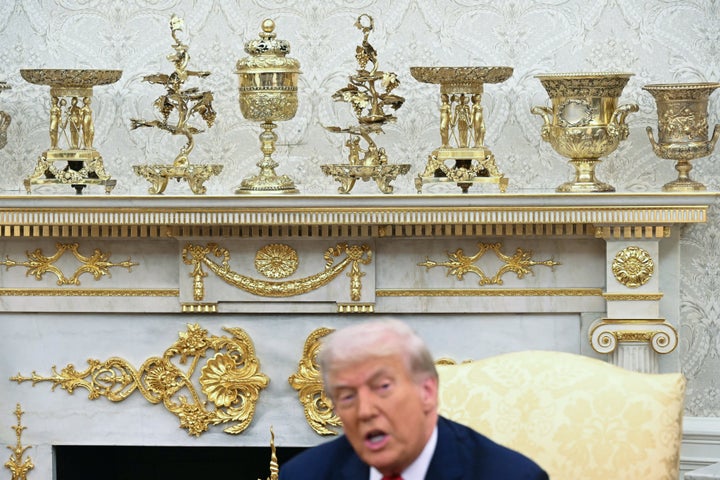
The White House has always taken on a bit of the color and personality of the people who reside in it, but President Donald Trump’s approach seems to be taking up a lot of his day-to-day brain space.
As the commander-in-chief who is currently overseeing two wars, a connected affordability crisis compounding the one that was ongoing, and trying to get ahead of what is forecasted to be a challenging slate of midterm elections for his Republican Party, we sure are hearing a lot about his vision for the proposed White House ballroom.
The decoration projects — and the slow creep of distinct (if aesthetically baffling) gold fixtures throughout the White House — seem never to be too far from his mind.
In September, he boasted on Truth Social that the Oval Office and Cabinet Rooms featured “some of the highest quality 24 Karat Gold” and that “Foreign Leaders, and everyone else, ‘freak out’ when they see the quality and beauty,” before concluding “Best Oval Office ever, in terms of success and look!!!”
These projects are, as experts told HuffPost, part of the role that many Americans associate with a different member of the first family — and it’s not the only area where the president appears more than game to step into what has historically been handled by the first lady of the United States (FLOTUS).

SAUL LOEB via Getty Images
“In the current Trump term, however, the president is in charge of White House renovations,” Katherine Jellison, a professor emerita of U.S. history at Ohio University and an expert in first ladies, gender in politics and women’s studies, told HuffPost. “He also seems to make most of the decisions about entertainers who perform at the White House. White House entertainment also used to be largely in the first lady’s domain.”
What Trump stepping on the toes of this role might actually tell us.
One interesting part of Trump’s public emphasis on his design work is how it subverts the gendered dynamics we all have come to expect from the FLOTUS.
“Yes, rehabbing the White House is a task more associated with first ladies than with presidents,” Jellison said. “In particular, people often think of Jackie Kennedy’s project to make the White House better reflect the nation’s history with historical furnishings, artwork, etc.”
Considering one of Trump’s earliest second-term projects involved literally tearing down the first lady’s domain (a choice even Melania Trump distanced herself from at the time), it can be a little hard to ignore what seems like a “disrespect” for the role of the FLOTUS, as Patti Wood, psychologist, nonverbal communication expert and author of “SNAP: Making the Most of First Impressions, Body Language and Charisma” told HuffPost.
“It’s interesting, in terms of the relationship with Melania,” Wood said. “Which [projects] does he say are his, which ones does he say are hers? But it always comes out that he feels like it’s his — even if it might be an event where it is her doing it, he moves in. Everything seems to be a reflection of him and his control,” citing projects like paving Jackie Kennedy’s rose garden and eventually adding the same patio umbrellas from Mar-a-Lago (which Melania Trump was reportedly “cool with.”)

To Wood, though, this emphasis on branding “the people’s house” as something very much in his image is “shocking” and can be seen as yet another way to assert his power over the people.
“It’s all dramatically overwhelming us with these are things that a president traditionally doesn’t decide [unilaterally]. Congress decides on this. The people decide on this. It is not a choice of a president,” Wood said.
“To say, ‘I’m going to control all of D.C., I’m going to control the White House, I am going to control all these things,’ is a power move and it makes us — because this is our White House, this is our capital — feel like we are powerless,” she continued. “It would be like somebody coming into your house, taking your prints, your photographs of your family off the wall, taking out your furniture and saying, ‘OK, I’m gonna decorate it my way. And now you have to live with it.’”
Former FLOTUS Michelle Obama made a similar observation when the East Wing was first demolished: “When we talk about the East Wing, it is the heart of the work. And to denigrate it, to tear it down, to pretend like it doesn’t matter — it’s a reflection of how you think of that role.”
Obama noted that it showed an all-too-common misunderstanding of the soft power of the role and the work done by first ladies to support the administration: “Whether the West Wing understood it or not, I used to tell them: All the stuff we do on the East Wing … those were five extra approval points that he got, because we provided a balance.”
But, weirdly enough, there’s a subversion of some entrenched gender roles going on here.
In the big year of 2026, we know that men can rightfully enjoy aesthetic and creative activities (like home decor, vibe curation and hosting) without it being a hit to their manhood. Likewise, we know women can take on meaty, complex work spanning issues that matter to them.
There are no clear rules — well, at least to those who aren’t committed to pushing the so-called “trad” worldview — on who gets to enjoy these things and do them well.
However, the head of the executive branch has many responsibilities that aren’t these things, and they’re pretty important. And, over the years, there’s been a general understanding, set from precedent, of what the FLOTUS’ responsibilities traditionally cover, for better or worse.
“Initially, the responsibility of the president’s wife, or her surrogate if the president was a bachelor or widower, was to serve as White House hostess and organize and supervise social and ceremonial events at the White House,” Jellison explained. “Before the 1930s, some first ladies took on other duties in addition to being a hostess, but the public expectation that a first lady should play a more public role as someone who involves herself in issues of social or political reform began in the 20th century.”
Eleanor Roosevelt is credited as “the person who most dramatically broke the mold and became a public figure in her own right,” Jellison noted, as her time in the White House from 1933-1945 introduced the new expectations of the first lady that we all recognize. Jackie Kennedy, too, was a well-known example of a FLOTUS who made stewardship of the White House and its history a part of her role.
The U.S. first lady’s role is unique compared to other spouses of heads of state, Jellison also notes, particularly because the American public expects them to leave behind so much of their identities when they step into the role.
That’s part of what makes Melania Trump a bit of an outlier, too. “In both her first and second terms as first lady, Melania Trump has maintained a lower profile than other recent first ladies,” Jellison said. “In both terms, sometimes weeks have gone by without a public appearance from Mrs. Trump. I think a key difference between the two terms is that when she is in the public eye in the second term, she is projecting an image of a businesslike woman in charge of her own life, destiny and perhaps historical reputation.”
And Trump’s emphasis on his own role in these design projects does, in its own weird way, demonstrate some subversion of these gender roles that so many Americans seem to believe are immutable.
In previous administrations, Wood said, “it would be considered not manly to do all of this, to choose the furniture, the artwork, all the little tchotchkes he has over the fireplace. That wouldn’t be a presidential choice.”

“If you talk about stereotypical male-female roles in design, the first lady would do the design, though she might have a male interior designer helping her. But that was the norm,” Wood added.
Again, citing Jackie Kennedy, Wood notes that all of those aesthetic decisions would be credited to the FLOTUS. “Her husband never, even for a moment, said he was responsible for any of that,” she said. “That would be her duty, her responsibility and her dictated gender role,”
Jellison does claim, however, that Trump isn’t the first president to take such a public role in renovations. “Theodore Roosevelt was very involved in the renovations of the White House that took place during his time in office,” she said.
“Like Trump, he was a larger-than-life figure who seemed to be everywhere all the time and making his stamp on the presidency and the nation,” Jellison continued. “Theodore Roosevelt’s daughter Alice used to say her father wanted to be the baby at every christening, the bride at every wedding and the corpse at every funeral. Teddy Roosevelt seems to be the historical figure who comes closest to Trump in terms of his view of the presidency and his desire to be at the center of both American politics and culture.”
She added, “I think, however, that Trump may be outpacing even [Roosevelt].”


