






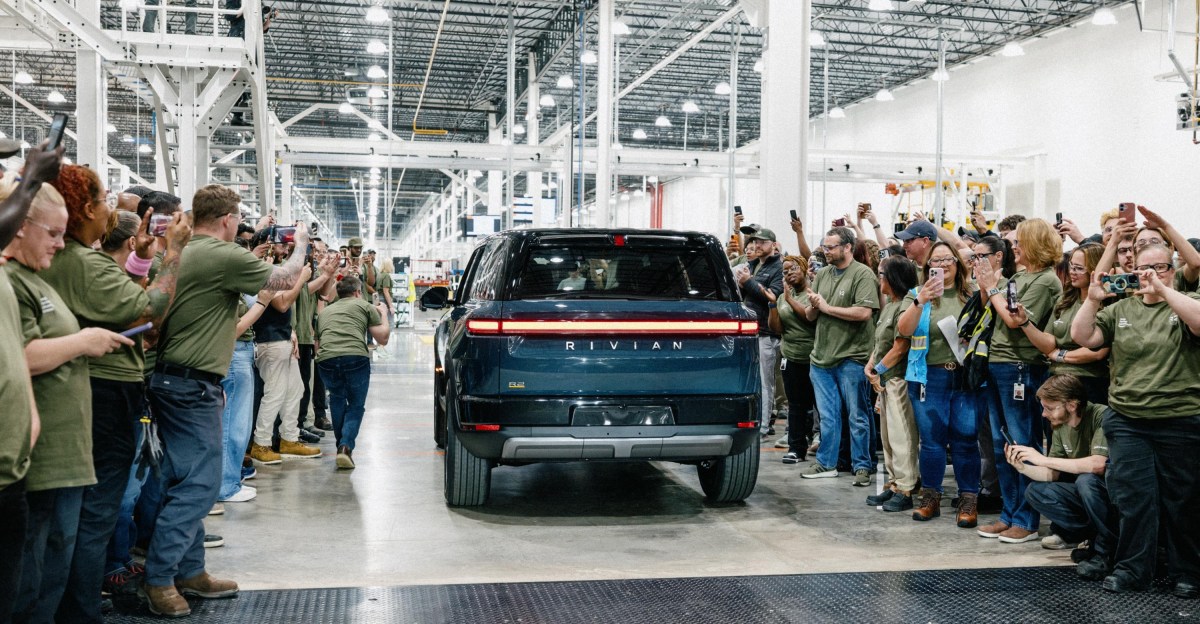
We’ve already got Rivian’s production and delivery statement from the first three months of the year. The company sold 10,365 vehicles in Q1, representing 20 percent increase year over year. And it produced 10,236 vehicles at its factory in Normal, Illinois, which represents a 30 percent increase compared to the same period last year. The company also reaffirmed its prediction that it will sell 62,000–67,000 vehicles this year.
In terms of earnings, Rivian said it brought in $1.38 billion in revenue, an 11.3 percent increase compared to the $1.24 billion in Q1 2025. Of that amount, $908 million came from automotive revenue, which is down 1.5 percent year over year. Comparatively, the company reported $473 million from software and subscription services, a whopping 48.7 percent increase year over year. As EV sales slow down, the company is seeking to make more money from its digital products, including the recently announced Autonomy Plus package.
Rivian’s gross profits were $119 million, a 42 percent decrease year over year. But its automotive profits recorded a loss of $62 million, compared to $92 million in gross profits in the same quarter in 2025, due primarily to the $100 million decrease in sales of automotive regulatory credits and lower production volumes.
Rivian said it brought in $1.38 billion in revenue, an 11.3 percent increase compared to the $1.24 billion in Q1 2025.
Rivian is betting that its more affordable R2 vehicle will help boost sales, especially as demand for EV cools down after the elimination of the federal $7,500 EV tax credit. The midsized SUV is crucial to the company’s future, as it seeks to secure a more stable financial position while investing heavily in a new factory and autonomous driving projects. A timely launch — the first R2s are expected to reach customers in June — is seen as vital to that success.
Rivian posted its first-ever gross profit in 2025, in part by slashing costs across the company. And it maintains it will achieve positive gross profit margins by the end of 2026. The company is also sticking to its goal of selling upwards of 20,000 R2 vehicles by the end of the year — even despite a tornado ripping the roof off a portion of the company’s factory in Normal earlier this month.
To that end, it’s been a busy few months for Rivian. The company announced its plans to design its own AI chips and add lidar sensors to future R2 models to help power fully autonomous driving. Last month, Rivian outlined the rollout of the R2, starting with higher-priced variants ranging up to $57,000 for the performance version. The much-touted base model, which starts at $45,000, won’t come out until the end of 2027.
In addition, Rivian hit a major milestone in its software joint venture with Volkswagen, unlocking an additional $1 billion in investment from the German auto giant. VW has said it would invest a total of $5.8 billion dollars in Rivian if it meets certain goals. The joint venture is developing a next-gen software platform, based on Rivian’s work in zonal architecture, that will eventually find its way in VW brands like Audi, Scout, and Porsche.
Lastly, the company landed a major deal with Uber to sell tens of thousands of R2 vehicles to the ridehail company for use as robotaxis. Uber said it would invest $1.25 billion as part of the deal, starting with $300 million at signing.