








Most redemptions in Chase’s travel portal now offer a meager value of 1 cent per point, but some Points Boost-eligible bookings provide a rare sweet spot. Depending on your card, Points Boost can raise the redemption value to as much as 2 cents per point when you book flights or hotels that qualify for the special designation. That might not be jaw-dropping value, but it’s not the loss it might first appear to be.
If you are set on booking business class for your next flight, you might find that you may spend less Chase Ultimate Rewards® points when you book a Points Boost-eligible business class flight, rather than transferring points to an airline partner and booking the business class flight through the airline’s loyalty program.
Because flights booked through Chase are treated as paid tickets, you’ll also earn airline miles and elite status credit. When you factor in these earnings, your effective value per point can exceed 2 cents.
Here’s how Points Boost works and when it can make sense to use it.
Regardless of which card you hold, each point is now worth 1 cent (10,000 points equals $100) when redeemed for travel booked through Chase unless the booking qualifies for Points Boost. There are four cards that now offer Points Boost on some travel bookings:
|
Old baseline value |
New baseline value |
New Points Boost value |
|
|---|---|---|---|
|
Chase Sapphire Reserve® |
1.5 cpp. |
1 cpp. |
1.75 to 2 cpp. |
|
Chase Sapphire Preferred® |
1.25 cpp. |
1 cpp. |
1.5 to 1.75 cpp. |
|
Ink Business Preferred® Credit Card |
1.25 cpp. |
1 cpp. |
1.5 to 1.75 cpp. |
|
Sapphire Reserve for Business® |
N/A. |
1 cpp. |
1.75 to 2 cpp. |
In many cases, Points Boost redemptions will yield a lower value than the prior fixed rates. However, there’s an important scenario where it can still pay off: when the cash fare (converted to points) roughly matches or beats an airline’s mileage pricing.
🤓 Nerdy Tip
Points earned before Oct. 26, 2025, can still be redeemed at the old rates (1.5 cents per point for the Chase Sapphire Reserve® and 1.25 cents for the Chase Sapphire Preferred® Card and the Ink Business Preferred® Credit Card) until Oct. 26, 2027. During that period, Chase will apply whichever rate results in the higher redemption value, whether that’s the former rate or Points Boost.
Example 1: Air Canada business class from Toronto to London
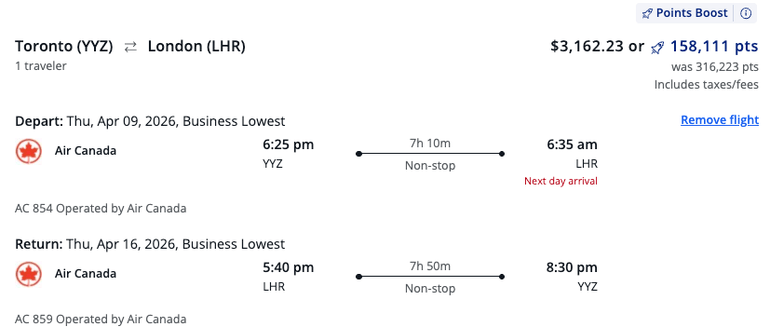
The distance between Toronto and London is 3,546 miles (7,091 round-trip). These flights would earn 10,636 Aeroplan points, which can be redeemed for flights booked with Air Canada or its Star Alliance partners.
If you’re pursuing elite status, those 10,636 Aeroplan points also count as Status Qualifying Miles (SQMs), putting you almost halfway toward the 25,000 SQMs needed for Aeroplan 25K, the program’s entry-level elite status tier.
We also checked the same flight on Air Canada’s website:
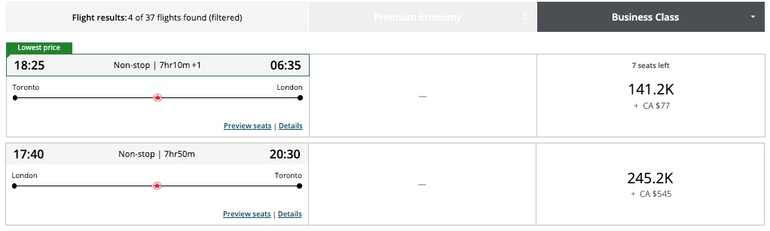
Booking directly with Air Canada would cost 386,400 points plus $443 in taxes and fees. Flights departing from London typically incur significant surcharges, which can make award redemptions less appealing since these fees are passed on to the customer. We also checked the price of this flight directly on Air Canada’s website, and it was $3,162, which is the same as through Chase.
In this case, Points Boost clearly wins. You’d redeem 158,111 points (about 79,000 points each way) and earn more than 10,000 redeemable Aeroplan points and progress toward status qualification. On Air Canada’s distance-based award chart, business class flights between zero and 4,000 miles start at 60,000 points one-way, and the chart shows a median price of 80,000 points.
If you’re able to find a seat for 60,000 Aeroplan points, booking directly with Air Canada would be the better deal. However, if you’re only seeing awards for around 80,000 Aeroplan points, booking through Chase makes more sense.
Example 2: Singapore Airlines business class from New York to Frankfurt
A business class ticket on Singapore Airlines from New York to Frankfurt cost $3,202 or 160,101 points if booked through Chase, equating to 2 cents per point with Points Boost.
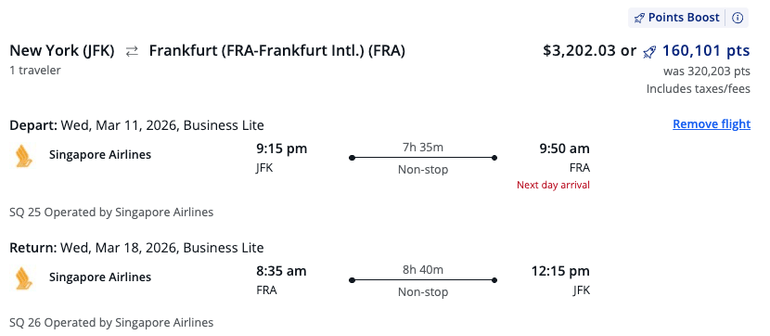
Singapore Airlines uses a zone-based award chart, and a one-way business class seat on this route costs 89,000 KrisFlyer miles (178,000 round-trip). Saver-level award space was available at that rate:
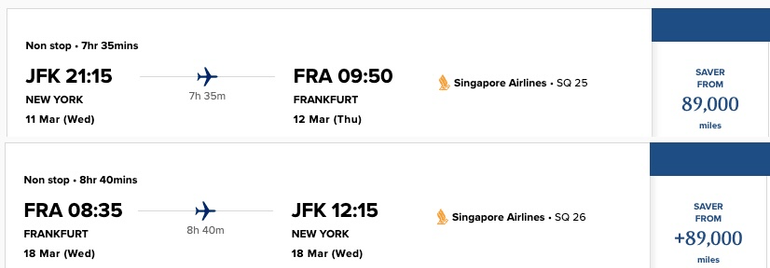
Booking through Chase would save you roughly 18,000 points compared with booking directly on Singapore Airlines. Because the Chase booking is treated as a paid fare, you’d also earn 9,618 KrisFlyer miles that count toward KrisFlyer Elite Silver status (which requires 25,000 Elite miles in 12 months). Since Singapore Airlines is also a Star Alliance member, you could credit the flight to any other airline in the alliance.
When we checked the same itinerary on Singapore’s website, the cash price was $2,839, which was about $363 cheaper than the Chase portal. Using that lower price, the effective redemption value drops to about 1.8 cent per point.
That’s not an outstanding value on paper, but if your goal is to use points instead of paying $2,839 in cash, Points Boost works in your favor. You’d redeem about 160,000 Chase points, which is fewer than the 178,000 miles that Singapore charges for the saver award (the cheapest redemption), and earn miles and elite credit on top of that. Even with Chase’s markup, this redemption can make sense if you prefer to use points instead of paying cash.
How to maximize Chase points with Points Boost
If a flight’s cash fare (converted at your card’s Points Boost rate) is close to or cheaper than what you’d pay by transferring points, booking through Chase can be the smarter play, especially for travelers who want to work towards elite status. At up to 2 cents per point, business class fares in particular can deliver strong value because you’ll also earn redeemable miles and elite qualifying credit on a paid fare.
The key is to compare both options. Before booking, check your airline’s award chart and Chase’s travel portal side-by-side. If the math looks similar, Points Boost might save you time hunting for award space, and you’ll earn miles and elite status credit along the way.