







Late last month, President Donald Trump joked about renaming the oil-shipping route the “Strait of Trump.” Days before Iran said the Strait of Hormuz would reopen amid a ceasefire between Israel and Lebanon, he floated the idea more seriously in a Fox News interview with Maria Bartiromo.
“You can call it the Strait of Hormuz or the Hormuz Strait. I said ‘Which is better?’ They said ‘Either is OK, you can call it either one. The only thing you can’t call it is the Trump Strait.’ They don’t like that idea,” the president said.
Suggesting ― subtly or not ― name changes for geographic locations and federal buildings has been a fixation for Trump since he took office again. On day one, he moved to rename the Gulf of Mexico ― a body of water bordered by the U.S., Mexico, and Cuba ― as the “Gulf of America.” (He’d toyed with calling it the “Gulf of Trump,” he recently said, but had a change of heart.)
He’s changed the names of several prominent federal buildings and institutions in Washington, D.C., too: The U.S. Institute of Peace is now the Donald J. Trump U.S. Institute of Peace, “to reflect the greatest dealmaker in our nation’s history,” the State Department fawningly tweeted.
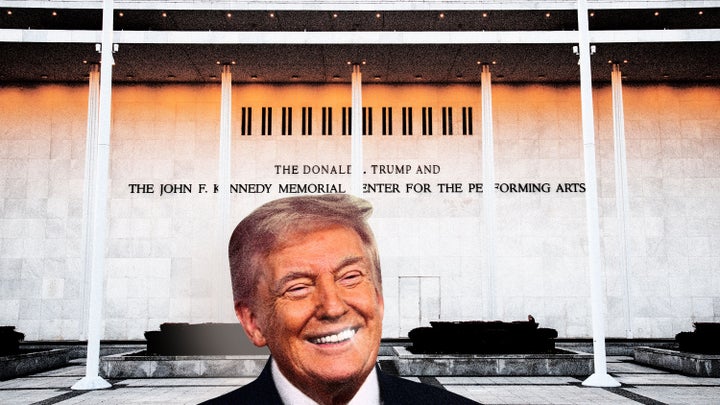
The John F. Kennedy Center for the Performing Arts, named for the assassinated 35th president, is now The Donald J. Trump and The John F. Kennedy Center for the Performing Arts.

Illustration: HuffPost; Photo: Getty Images
Renaming a building for a president is usually bestowed by an act of Congress or state or local officials. Trump has acted unilaterally.
“Most previous presidents did not want to name things for themselves or have entities named for them during their lives, except for their libraries, of course, because they didn’t want to appear self-serving or self-aggrandizing,” said Barbara A. Perry, a professor in presidential studies at the Miller Center at the University of Virginia.
Trump, however, is dead set on attaching his real estate empire’s branding on any D.C. building (or airport, like Dulles International) he can get his hands on.
“Trump follows his long-standing business model of self-branding, which is not particularly unusual in the business world: think Ford cars and Hilton hotels, for example,” Perry told HuffPost.
“Authoritarian leaders are also prone to make their name, image, and likeness as prominent as possible, to have their people both admire and fear them,” Perry said.
Reuben Rose-Redwood, a professor of geography at the University of Victoria in British Columbia, Canada, thinks that Trump’s fixation on renaming places after himself is a textbook case of what he calls “toponymic narcissism.”

Bloomberg via Getty Images
“I’ve often likened Trump’s toponymic narcissism to the behavior of a pufferfish or blowfish that enlarges itself to give the appearance of strength to overcompensate for its weaknesses and vulnerabilities,” he explained. “It’s a geographical form of self-aggrandizement that we typically see in cults of personality associated with authoritarian dictators.”
Judging by Trump’s musings on the Strait of Hormuz and the “Gulf of Trump” last week, the president is clearly still in name-change mode. What would it actually take to restore the names of buildings and bodies of water changed under Trump? Here’s what geography and presidential experts told us.
The Federal Buildings
Democrats are already pushing to restore federal building names: In a motion last month, Rep. Joyce Beatty (D-Ohio) asked a federal judge to block efforts to add President Trump’s name to the John F. Kennedy Center for the Performing Arts, arguing Congress intended it to honor John F. Kennedy alone.
Sen. Bernie Sanders (I-Vt.) and other Democratic senators proposed a bill in January to prohibit naming federal property after sitting presidents: The aptly named Stop Executive Renaming for Vanity and Ego (SERVE) Act.
So if a Democrat is elected president and if the Congress has one or both houses with a Democratic majority, Perry thinks it’s highly likely that any renamed federal institution will revert back to its original name, or perhaps another new name.
“Congress or the General Services Administration ― an independent agency of the U.S. federal government established in the 1940s to manage and support the basic functioning of federal agencies ― have the authority to name federal buildings,” Perry said. “Of course, Trump ignored that fact.”

The Washington Post via Getty Images
The Gulf Of America And Mount McKinley
On the day of his inauguration in January 2025, Trump issued an executive order officially directing U.S. federal agencies to rename the Gulf of Mexico to the Gulf of America.
He also reverted the name of Alaska’s Mount Denali to Mount McKinley, stating the move was meant to honor the 25th U.S. President, William McKinley, as part of “restoring” American heritage. (The peak is no stranger to politically driven name changes. In 2015, President Barack Obama exercised his executive authority to restore the name “Denali” to the mountain ― the name used by Alaska Native people for thousands of years.)
“With Trump, I can’t help but notice that the overall direction of renaming is to eliminate indigenous names, whether this is Denali, Mexico, or Hormuz,” said Bill Rankin, a history professor at Yale University, where he focuses on the history of mapping and the geographic sciences.

Lance King via Getty Images
In any case, the “Gulf of America” hasn’t exactly caught on. While the U.S. Geographic Names Information System adopted the changes, followed by mapping platforms like Apple Maps, Google Maps, and Bing Maps, international charts and foreign governments, including Mexico, continue to use the historical name for the body of water.
“Beyond the borders of the United States, the ‘Gulf of America’ renaming is unlikely to have any lasting influence on global cartographic conventions,” Rose-Redwood said.
No single country holds a monopoly over the naming of places in international waters, he said, though some international bodies, such as the International Hydrographic Organization and the United Nations Group of Experts on Geographical Names, have promoted the global standardization of place names.
The next president could issue a new executive order to change the names of the Gulf of America and Mount McKinley back to their pre-Trump designations in the U.S., Rankin said. The next administration could also quietly encourage the U.S. Board on Geographic Names to reconsider the names, or pick new names altogether.

JIM WATSON via Getty Images
“My best guess is that a Democratic president would find a way to change the names back, but a Republican president wouldn’t. But the easy answer is that I don’t know,” he said.
Gene Rhea Tucker, a professor of history at Temple College in Temple, Texas and board member of a group called the Texas Map Society, thinks most Americans will continue to call it the Gulf of Mexico.
“Generally, place-names generally endure when they are short and easy to pronounce, have no popular rival, and are tied to the land or its people rather than a political system or person,” Tucker said. “It’s why ‘Gulf of New Spain’ lost out to ‘Gulf of Mexico,’ and why today’s “Gulf of America” will likely revert to “Gulf of Mexico” once the political moment passes.”
The Independence Arch (or as it was originally proposed, the Arc de Trump)
The “Independence Arch” is a proposed 250-foot-tall structure, initially dubbed the “Arc de Trump,” planned for a traffic circle near the Lincoln Memorial and Arlington National Cemetery, and designed for the 250th anniversary of American independence.
New renderings for the projected $100 million monument reveal an ambitious structure inspired by Paris’s Arc de Triomphe, featuring 24-foot golden eagles. Right now, the grandiose-looking structure is still in the design and review phase.

There are some legal challenges to building it: A group of residents in the Washington, D.C., area is suing to block construction of the arch, arguing that the Trump administration failed to follow federal laws that restrict new commemorative works in the region, according to Reuters.
If progress continues to be stalled and the monument isn’t underway by the time Trump is out of office, Perry thinks it won’t happen.
“If Trump’s arch is not very far along, it might be stopped and the space returned to its pre-Trump design,” she said.
There’s some precedent for a presidential dedication being thwarted: Construction on the Hoover Dam began under President Herbert Hoover, but when his successor, Franklin D. Roosevelt, dedicated it in 1935, he pointedly avoided using Hoover’s name. Although Interior Secretary Ray Lyman Wilbur had officially named it “Hoover Dam” in 1930, the name was still politically contentious during the Great Depression.
The East Wing White House Ballroom

Eric Lee via Getty Images
While there is no official name for the East Wing White House ballroom Trump is building, ABC reported in October that deferential staffers have taken to calling it “the President Donald J. Trump Ballroom.”
We’ll see if it’s eventually named for Trump, as the Truman Balcony was for our 33rd president, Perry said.
“If the ballroom is already far along, it will probably have to be kept,” she said. Still, she said, “Wouldn’t it be interesting if a court ordered Trump to rebuild the East Wing at his own expense or that of his patrons?”