






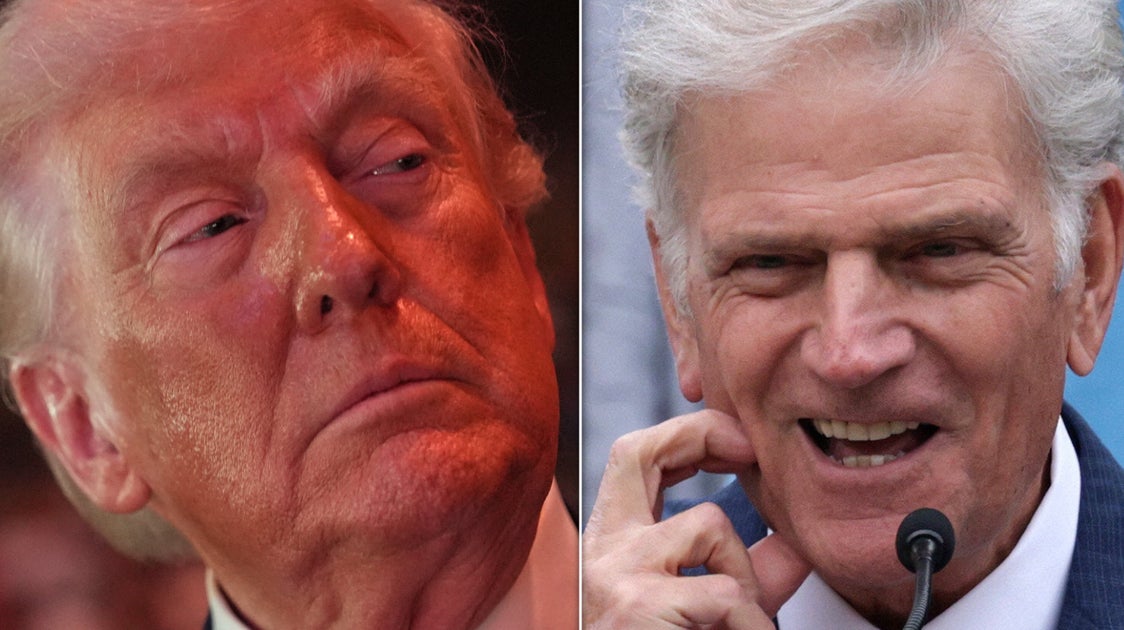
On Thursday, Franklin Graham, son of the late evangelist Billy Graham — and a longtime prominent ally of Trump — took to X to vehemently defend President Donald Trump for posting an AI-generated image that depicted him as a Jesus-like figure earlier in the week. Graham said that he didn’t believe Trump would “knowingly depict himself as Jesus Christ.”
He also said he was “thankful” that Trump had since made it “very clear” that he believed the AI image depicted him as a doctor “helping someone,” not Jesus.
“When he learned of the concerns, he immediately removed the post,” he said.
Deepak Sarma, inaugural distinguished scholar in the public humanities at Case Western Reserve University, said that Graham’s statement “highlights how certain expressions of MAGA Christianity have drifted, both conceptually and ethically, from the core of the Christian tradition.”
“What emerges is not a sustained engagement with moral reasoning, but the repetition of a narrative that privileges loyalty over discernment and even permits/celebrates blasphemous behavior,” they said.
The image Trump posted on his Truth Social platform depicted him wearing white and red robes, with light emanating from one of his hands while the other hand was apparently healing a sick man. The post was denounced by religious leaders and by people across the political spectrum — including some of Trump’s most outspoken supporters.
Trump removed the photo amid backlash and claimed the following day that he thought the image depicted him as a doctor.
Despite the backlash to the image — and that Trump was widely mocked over his subsequent excuse for the post — Graham suggested on X that he didn’t come to the same conclusions as just about everyone else who thought Trump was depicting himself as Jesus.
“There were no spiritual references — no halo, there were no crosses, no angels. It was a flag, soldiers, a nurse, fighter planes, eagles, the Statue of Liberty, and I think this is a lot to do about nothing,” he wrote. “There is so much ill-intended speculation. I think his enemies are always foaming at the mouth at any possible opportunity to make him look bad.”
Graham went on to defend another Jesus post that Trump shared on Truth Social on Wednesday. The president posted a screenshot of another post that featured an image of Jesus embracing him. Graham said he liked the image.
“I must say that I like the fact that this is a picture of Jesus whispering in his ear, or at least His hand on his shoulder, guiding him,” he wrote. “We all need that — we all need to be listening to Jesus.”
Graham later added that Trump is “the most pro-Christian, pro-life president in my lifetime, and he doesn’t shy away from it.” (Read his full statement here.)
People on X were left stunned by Graham’s total defense of the image, including former Rep. Marjorie Taylor Greene (R-Ga.), who said that Graham making excuses for Trump was “one of the worst things I’ve seen.”
“Franklin Graham of all people, who is frequently at the [White House] and with Trump, should be leading Trump to be a Christian, NOT telling other Christians that Trump did nothing wrong when he committed blasphemy,” she wrote.
Sarma, who received a Ph.D. in the philosophy of religions at the University of Chicago Divinity School, told HuffPost that Graham’s post was revealing, “though not in the way it is intended.”
Sarma noted that Graham’s statement on X showed familiar patterns that we’ve seen from the president.
“Graham’s remarks closely track Donald Trump’s familiar rhetorical patterns: deflection, revision, and the redistribution of responsibility onto the audience —classic gaslighting,” they said.
Sarma said that Trump’s explanation that he thought he was depicted as a doctor in the AI post functioned as a “retroactive meaning-making” — which is “textbook narrative manipulation.”
“More troubling is the implication that any misreading lies with the audience rather than with the act itself,” they said.
Sarma said that Graham’s recent statement and alignment with Trump is “difficult to reconcile” from a theological standpoint.
“The Christian tradition has long emphasized humility, truthfulness, and self-scrutiny, virtues that are notably absent in this exchange,” they said. “What we see instead is a willingness to subordinate those commitments to political expediency.”
Graham has been criticized for his outspoken support for Trump before.
In 2021, Graham compared Republicans who voted to impeach Trump for inciting his supporters to storm the Capitol to Judas Iscariot, the apostle known for betraying Jesus. He has also publicly expressed doubts about the 2020 election results, which resulted in former President Joe Biden’s victory over Trump.
Graham began his prayer at Trump’s inauguration last year by saying, “Mr. President, the last four years, there are times I’m sure you thought it was pretty dark. But look what God has done.”
William Willimon, a bishop in the United Methodist Church, an author and a professor of the practice of Christian ministry at Duke Divinity School, previously told HuffPost that he believed Graham’s remarks at the inauguration were “divisive” and “political.”
Sarma said that overall, Graham’s recent defense of Trump’s AI post reflects, at a broader level, “a system in which affirmation sustains belonging and dissent carries cost.”
“Even those with significant influence appear reluctant to challenge the prevailing narrative,” they said, before adding: “Some MAGA (and non-MAGA Christians) are seeing Graham’s defense of Trump for what it is: a poorly veiled attempt to curry favor with Trump and also to maintain status as a high profile faith leader.”