






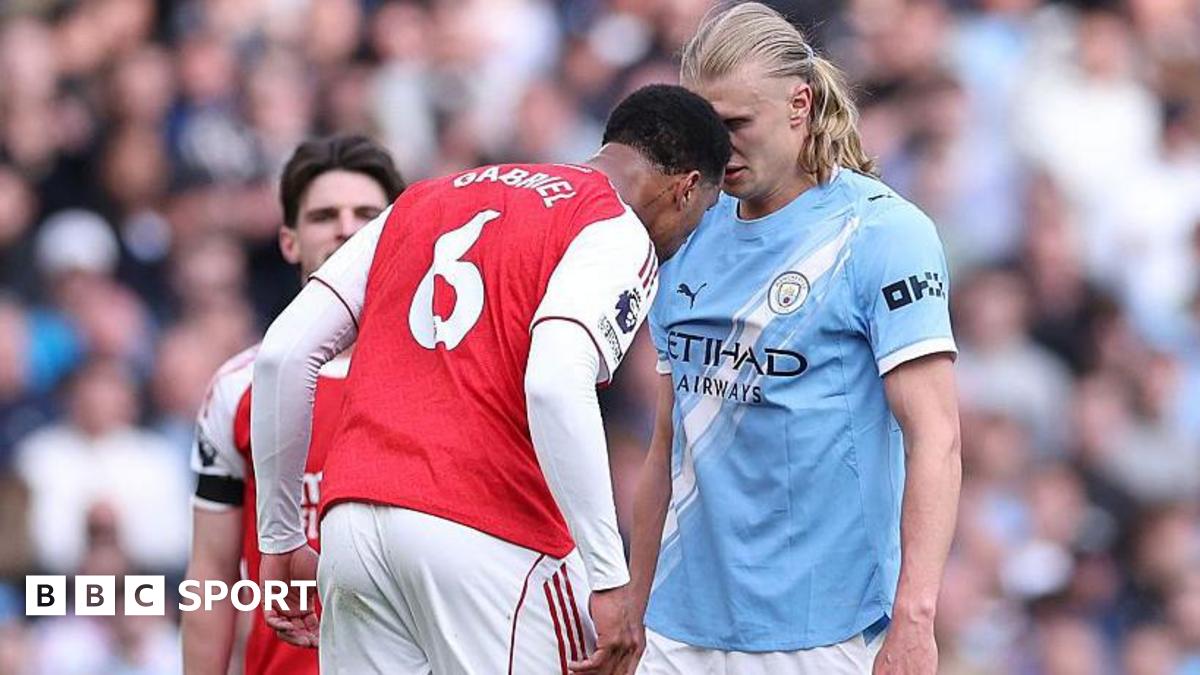
Gabriel has a lot to thank Haaland for. Had the striker gone down, embellishing the level of contact, a VAR review feels like it would have been a certainty.
This is often the problem. A VAR is looking for evidence of impact to convince them there has been a mistake.
If a player does not react, be that to a headbutt or a trip or a push, it is far more difficult to be sure there has been an offence.
Yet that only encourages players to play up for the cameras to make sure they get the decision they want.
For instance, had Calvert-Lewin not gone down holding his hair would Brooks have even picked up on that potential red card?
And we have a perfect example for comparison.
In November 2020, Taylor was in charge of Leeds against Arsenal when, with the referee’s back turned, Nicolas Pepe walked up to Ezgjan Alioski and placed his forehead into the face of the North Macedonia international.
The level of contact does not seem too much different to Gabriel and Haaland’s clash, yet Alioski fell to the ground holding his face.
Pepe was sent off after a VAR review, with Gunners boss Mike Arteta saying at the time that his actions were “unacceptable”.
One problem the Premier League has is the high threshold for VAR intervention, which often means the most logical decisions are not reached.
It is why there are far more missed interventions (15) so far this season compared to incorrect ones (three), a trend which has been there throughout all seven seasons with video reviews.
Yet in an era where players seem eager to throw themselves to the ground, it is refreshing that Haaland did not over-react.
“If I go down like any other guy, it’s a red card,” Haaland said after the game.
“It’s not something I would do. My father taught me to stay on your feet.
“Should I have gone down? Maybe. Then it would’ve been easier.”
City boss Pep Guardiola will be hoping it does not come back to haunt his team if Gabriel proves to be a match-winner for Arsenal over the next three games.