







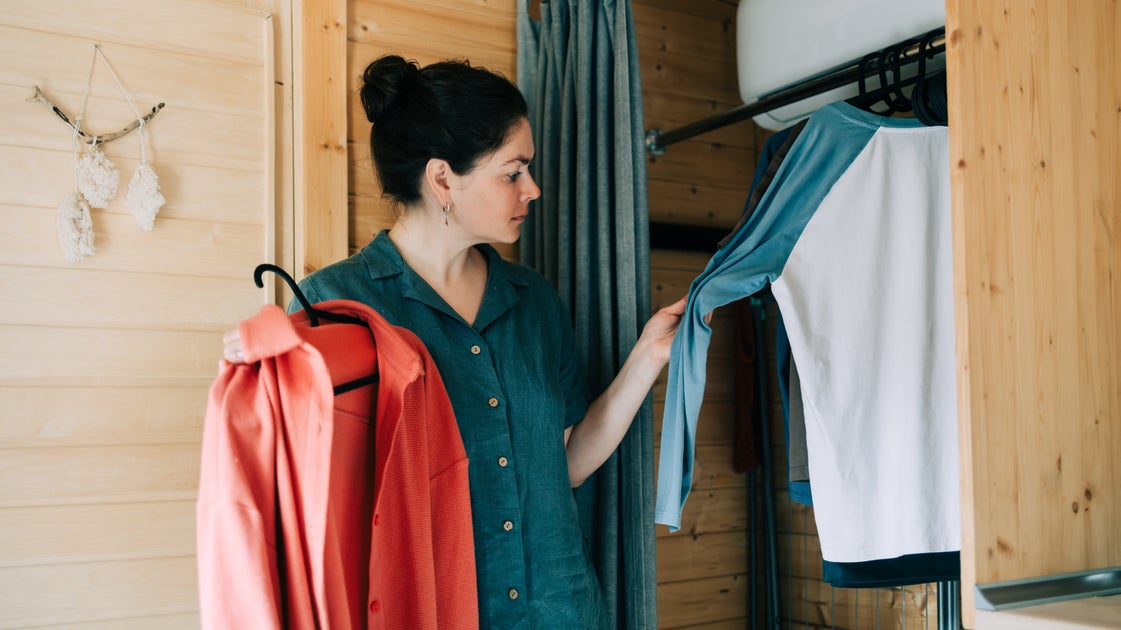
The sun is out, the birds are chirping and our homes are likely in need of a little spring cleaning. While a snowy winter might’ve had us wrapped up in the hygge of it all, some of us are looking around and wondering how we accumulated so much coziness — aka clutter.
When it comes to letting go of stuff, there’s a spectrum. On one end are the extreme minimalists who have no issue bulldozing through the crap and shoveling it all into bags to donate to Goodwill. On the other end are the sensitive marshmallows who attach sweet memories to everything, from their seventh-grade soccer shorts to their great-grandma’s chipped china.
So how do we find the sweet spot and keep what should be kept while ridding ourselves of the pieces that need to be shown the door?
That’s what we — Raj Punjabi-Johnson and Noah Michelson, co-hosts of HuffPost’s “Am I Doing It Wrong?” podcast — asked Anita Yokota, a psychologist turned interior designer, when she recently dropped by our studio to chat about all things clutter.
“When it comes to sentimental things, there’s an ambivalence,” Yokota, whose work is dedicated to centering wellness in our living spaces, told us. “There’s this time that we really need to let it marinate, so I have a method. It’s called ‘the holding box.’ I have all my clients put all the things they’re ambivalent about, have mixed feelings about [in it].”
The box is a physical container, Yokota noted, but by using it, her clients also create a “mental container” to grapple with their connection to the items and what to do with them.
“Usually out of a closet, there’s like three to five things they really don’t know what to do with,” she said. “I give them a time. So, it’s 24 to 48 hours. It’s not a week. It’s not a month. It’s about two days.”
Yokota, the author of “Grounded Living: Harmonizing Design and Nature in the Home,” believes this is just enough time to steep in the feelings and memories that the object evokes, but not so much that we’re languishing without making a decision. It’s a specific formula meant to avoid overthinking or impulsive tossing.
“It’s the messy middle. We want to get from A to Z, [just] like that. And as you know, life is … rarely black and white,” Yokota said. “So when we have these emotional ties to objects, it’s not black and white. But we’re imposing the decision from a black-and-white process — like toss or keep. But there’s this emotional element we’re not acknowledging. … Acknowledging that part helps our mind unlock the struggle, and then, that clarity can come.”
The holding box becomes a “very helpful ‘in the mess’ process tool for [my clients] to overcome [their uncertainty and] get to that decision.”
Michelson shared a few other tools he’s heard about to aid in decluttering decision-making, including “the poop question.”
“If you have a whole bunch of stuff and you can’t decide if you should get rid of it — you haven’t put it in the holding box that you have … you’re supposed to ask yourself, ‘If this had poop on it, would I still want to take the time to clean it and keep it?’” Michelson explained. “Most people are like, ‘If that had poop on it, I would just get rid of it,’ but there are certain things that you would [clean]. You’d be like, ‘No, I want this.’”
Another tool you can use is “the ex test.”
“This is less about, like, getting yourself to declutter and it’s more when you’re in the heart of [decluttering] and you’ve got a closet full of clothes and you know you’re not wearing all of them and you could definitely donate some, but you’re having a hard time [deciding what to let go],” Michelson said. “You can also ask yourself, not if it had poop on it, but, ‘If my ex-boyfriend had those jeans, would I go through the work to contact him to get them back?’ … Would it be worth the trouble of getting in touch with an ex we hated to get them back?”
Regardless of which tool you use to help decide what to keep and what to throw out, Yokota emphasized that our living spaces and our mental well-being are delicately and inextricably intertwined. That’s why having too much stuff — or too little in some cases — can affect our day-to-day moods, as well as our long-term mental health.
We also chatted with Yokota about the brain science behind how clutter affects us, how our childhoods color our perspectives on mess, which room to begin our decluttering in, and much more, so click above to hear the full episode or listen wherever you get your podcasts.
You can also watch the full episode on YouTube.
For more from Anita Yokota, head here and find her on Instagram here. To order her new book, “Grounded Living: Harmonizing Design and Nature in the Home,” click here.
Have a question or need some help with something you’ve been doing wrong? Email us at AmIDoingItWrong@HuffPost.com, and we might investigate the topic in an upcoming episode.