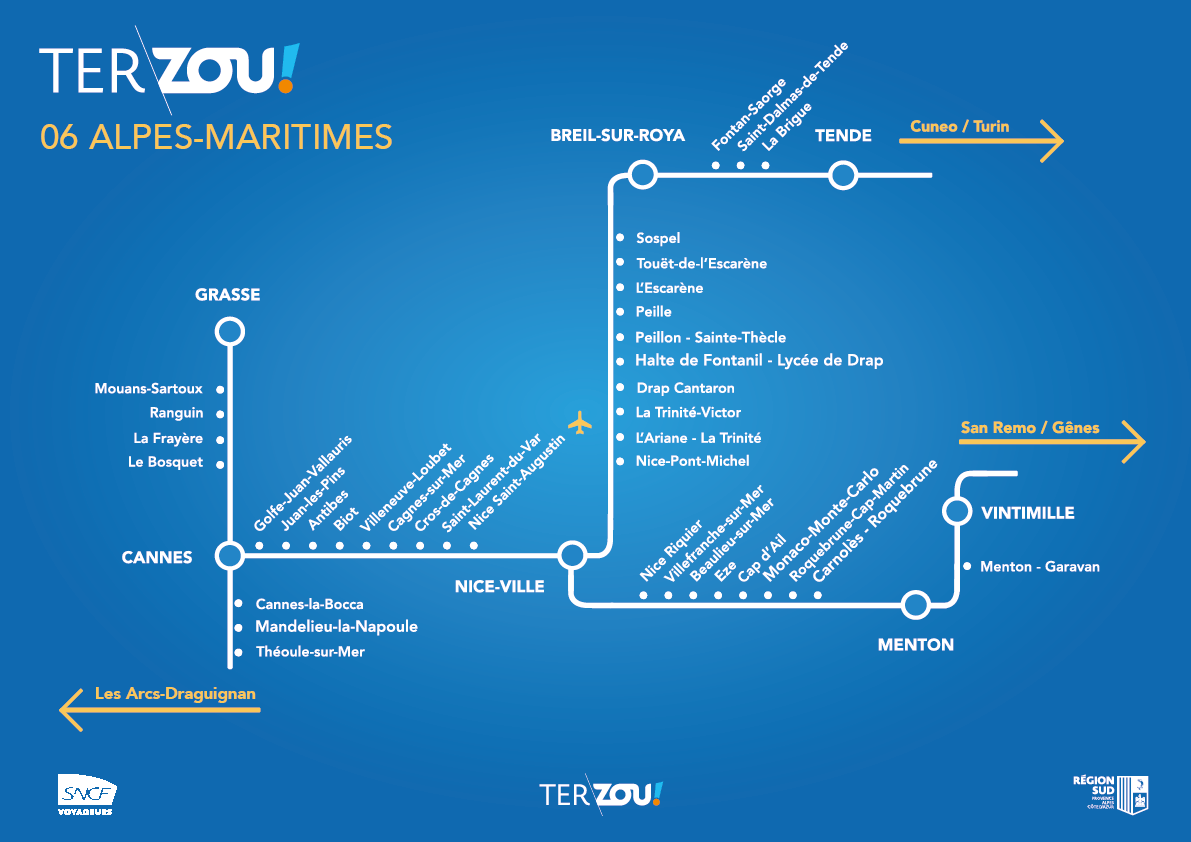









Nine-thirty on a sunny Tuesday morning, and the platforms at Nice-Ville station are buzzing. Office workers nudge their way past backpackers, passengers clamber on to trains heading east to Monaco and Italy, or west to Antibes and Cannes. My husband and I, however, are heading away from the glittering coastline and boarding the Train des Merveilles (Train of Wonders) into the Alpes-Azur mountains.
Back on track last December after a programme of major works closed the line for a year, it’s one of the most spectacular train routes in Europe, a two-hour journey that climbs 1,000 metres in 100km, linking Nice with the medieval town of Tende, surrounded by the soaring peaks of the Mercantour national park.
It’s barely 10 minutes before the suburbs of Nice begin to melt into low hills, scattered with auburn-roofed villas and copses of chestnut trees. Once the ascent begins, it’s easy to see why maintaining the line, begun in 1883, is a serious task. More than 100 bridges and viaducts – and almost as many tunnels and retaining walls – stitch the track together, along with ingenious helical loop tunnels, which gain altitude by following a series of bends inside the mountain itself.
It’s a breathtaking ride, the hills gaining height and heft, until a great mountainscape begins to unfold before us; jagged peaks that make the valley road below seem little more than a thin sliver of ribbon.
Many passengers ride straight up to Tende and set off to hike the mountain trails that lead off from the town. But we want to see a little more, and disembark first at Sospel, a medieval town where the 13th-century Pont-Vieux straddles the Bévéra River. It’s market day and, even in such a small town, there are flower and vegetable stalls, great wheels of cheese and delicious looking breads. We stroll the quiet streets, past crumbling baroque churches and gothic-style houses. It’s amazing to think we are barely an hour from Nice – it feels like we’ve been transported to an entirely different region of France.
The higher we go, the more the feeling of stepping back in time grows. At La Brigue, the gateway to the Mercantour national park, the tangle of medieval streets feel barely raised from their winter sleep; the town only really comes alive in summer, when the hikers arrive. La Brigue’s claim to fame is the Chapel of our Lady of Fountains, a couple of miles outside the town. Named for the seven springs that trickle through the rocks nearby, parts of the church date back to the 13th century, when, legend has it, villagers built it as a sign of gratitude to the Virgin Mary after prayers for a new water source for La Brigue were answered. While the facade is unassuming, the interior is truly extraordinary; its walls and ceiling are covered in 15th-century frescoes by Giovanni Canavesio that are so vivid the church is sometimes called the Sistine Chapel of the Southern Alps.
By the time we arrive in Tende, where the houses cling to the mountainside, we are 800 metres above sea level and there is nothing but wooded slopes leading to high peaks and a crisp, clear silence. We follow the modern main street through the clustered, medieval houses of the old town up to the ruins of Chateau Lascaris, where the views stretch to the distant peaks of the Marguareis massif, the last mountains before Italy. It’s quite a pull, and afterwards we reward ourselves with mammoth croque monsieurs at Stella Alpina – part outdoor equipment shop, part rustic eaterie. Around us, hearty looking chaps in Lycra cycling tops are tucking into pints of lager and platters of local cheese and cured meats.
Much restored, we dip into the Musée des Merveilles, where we learn (through our fractured French) that the area is home to one of Europe’s largest Neolithic and Bronze Age rock-engraving sites. The town’s more recent (relatively speaking) history is tied to the Salt Road, a mule train route between the Piedmontese Alps and the Ligurian coast, used from the middle ages until the 18th century. Built as the last French stop-off along the trade route, it partly explains why a town of such a size was located in such an isolated, mountainous location.
Next morning, we’re back in Nice, from where we head along the coast to Antibes. It’s such a bonus, being able to explore so easily; 40 minutes later, we’re strolling past gleaming yachts in the marina and on to the 16th-century ramparts, to sit in the sunshine and watch the kitesurfers whisk across the bay. We head to a restaurant on the Place Nationale, where I eat crispy fritto misto (mixed fried seafood) and try to ignore my husband tucking into buttery, garlicky snails. The following day we take the 10-minute hop east for lunch in Beaulieu-sur-Mer, where the streets ooze belle epoque glamour, and the Plage de la Petite Afrique makes the perfect spot for a paddle and a pile of mussels, thick with cream and garlic.
Food, inevitably, plays a big part in our time in Nice too. As touristy as the old town is, we find two absolute gems; a recommendation sends us to Acchiardo (on Facebook), where the fourth generation of the Acchiardo family serves up classic local dishes such as daube Nicoise – a rich, slow-cooked beef stew and duck breast with fig sauce. The second, Les Bar Des Oiseaux (on Instagram), we simply stumble across. It’s a classic bistro, with wood panelling painted with flawless reproductions of artworks by everyone from Joan Miró to Paul Klee and Roy Lichtenstein. My bourride (a traditional Provençal fish stew) was one of the most delicious things I’ve ever eaten.
And that’s the beauty of Nice. It’s both a destination itself and a gateway to very different worlds, all of them just a train ride away. The Train des Merveilles is unarguably the highlight; those extraordinary twists and turns, the grandiose scenery, wild and untouched, so different from the busy streets of Nice. But to pack all of it into one short trip is to make the very most of this diversely beautiful region; a trip des merveilles indeed.
The trip was provided by Mama Shelter hotels and the Nice Côte d’Azur tourist board. Doubles at Mama Shelter Nice from £114 B&B. The Train des Merveilles runs daily from June-September, with an onboard guide on the 9.30 departure. A regional rail day pass with Ter Zou!, including the Train des Merveilles, is €20