




Investing in exchange-traded funds (ETFs) is one of the most effortless ways to build long-term wealth. Each fund may hold dozens or hundreds of stocks, allowing you to generate passive returns over time with minimal effort.
Choosing the right ETF is key, however, as some funds are riskier than others. While everyone will have their own personal preferences and goals, there’s one Vanguard ETF I’ve owned for years and will continue to hold for as long as I can: the Vanguard S&P 500 ETF (VOO +0.40%).
Image source: Getty Images.
A powerhouse investment endorsed by Warren Buffett
S&P 500 ETFs are a staple in many investors’ portfolios, and they also come highly recommended by investing legend Warren Buffett. A few years ago, during Berkshire Hathaway‘s annual meeting, he even went so far as to call investing this way “the best thing” for most investors.
There are good reasons why this type of investment is so popular. For one, it offers stellar diversification, with exposure to just over 500 large-cap stocks across all market sectors. The companies within the S&P 500 are among the largest and strongest in the U.S., making this ETF more likely to recover from bear markets and recessions.

Today’s Change
(0.40%) $2.71
Current Price
$685.55
Key Data Points
Day’s Range
$684.48 – $688.58
52wk Range
$536.16 – $689.10
Volume
4.3M
While there are no guarantees in the stock market, the S&P 500 ETF is about as close as you can get to guaranteed positive long-term returns. The key, though, is to stay invested for the long haul.
Over the S&P 500’s history, around one-third of its one-year periods have ended in negative total returns, according to analysis from investment firm Capital Group. This means that if you buy an S&P 500 ETF and hold it for just one year, there’s historically a 33% chance you’ll lose money. However, over the last 82 years, none of the S&P 500’s 10-year periods have ended in negative total returns.
This trend holds up in recent history, too. Over the last couple of decades, the S&P 500 has experienced no shortage of downturns — from the dot-com bubble burst to the Great Recession to the COVID-19 crash and the 2022 bear market. Yet since January 2000, the index has surged by a staggering 721%.
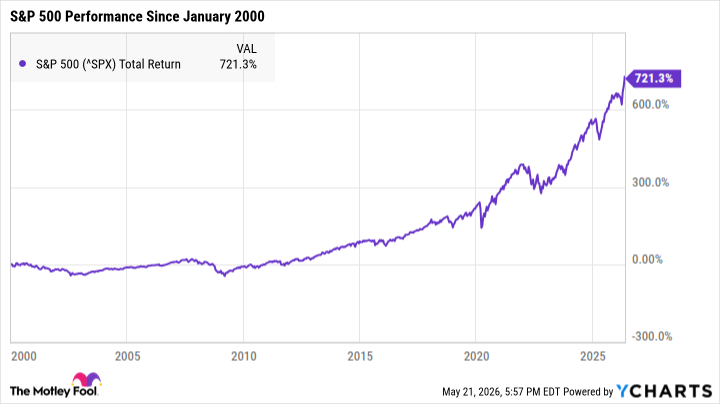
In other words, if you’d invested $1,000 in an S&P 500 ETF in January 2000, you’d have more than $8,200 by today — even if you didn’t make any additional contributions in that time. Past performance doesn’t predict future returns, but the S&P 500 has an impressive history of outperforming over time.
One downside to consider with the S&P 500 ETF
The Vanguard S&P 500 ETF is a powerful long-term investment, but it’s also a broad-market fund that aims to track a major market index. This means it can only ever earn average returns. Compared to, say, a growth ETF, those average returns could hold you back over time.
Over the last 10 years, the Vanguard S&P 500 ETF has earned an average return of 15.21% per year. For comparison, the Vanguard Growth ETF (VUG +0.07%) — which holds roughly 150 large-cap growth stocks and is designed to beat the market — has earned an average annual return of 17.77% in that time.
If you were investing $200 per month in each fund at those average annual returns, here’s approximately how it would add up in both scenarios:
| Number of Years | Total Portfolio Value: VOO: 15.21% Avg. Annual Return | Total Portfolio Value: VUG: 17.77% Avg. Annual Return |
|---|---|---|
| 20 | $252,000 | $342,000 |
| 25 | $528,000 | $793,000 |
| 30 | $1,088,000 | $1,813,000 |
Data source: Author’s calculations via investor.gov.
The difference between 15% and 17% average annual returns may seem minor, but it could add up to hundreds of thousands of dollars over time.
This may not be a dealbreaker for everyone. Growth ETFs tend to have higher risk profiles and greater volatility, and the lower earning potential of an S&P 500 ETF may be a worthwhile trade-off for relative safety and stability. But if you’re looking to maximize your earnings in the stock market, this fund may fall short of expectations.
No matter where you buy, a long-term outlook is key. By staying invested through the market’s ups and downs, you could generate hundreds of thousands of dollars while barely lifting a finger.