





The world is in a highly uncertain state today. And still the S&P 500 index (^GSPC +0.37%) is hovering near all-time highs. But volatility from day to day has been high, suggesting that often mercurial investors are worried about the future. That’s reasonable in the short term, but the long term is a different story. If you are a patient investor, history suggests you’ll be just fine if you ignore the emotional swings that are driving stock prices today.
Here’s what you need to know about Wall Street history to keep you focused on your own, personal long-term investment plan.

Image source: Getty Images.
Listen to the oracle of long-term investing
Investors can easily buy the S&P 500 index through exchange-traded funds such as SPDR S&P 500 ETF (SPY +0.45%) or Vanguard S&P 500 ETF (VOO +0.40%). The S&P 500 index is the most common investment for those looking to simply track the market. Long-term investors like Warren Buffett, the former CEO of Berkshire Hathaway (BRKA +1.43%)(BRKB +1.32%), often suggest that buying the S&P 500 index is the best option for smaller investors. It lets you own stocks with little effort.
The focus from there can be on two fronts: Saving as much money as you can and sticking it out through the market’s inevitable ups and downs. The first part of that can usually be set on autopilot, either through your employer’s retirement plan or through automatic deposits to your brokerage account. The second piece could actually be the hardest, because emotions are so important to long-term investment success and change so quickly on Wall Street. Buffett, whose investment results were so strong he earned the nickname the Oracle of Omaha, has explained that temperament is even more important than intelligence when it comes to investing.
A few examples of what could happen from here
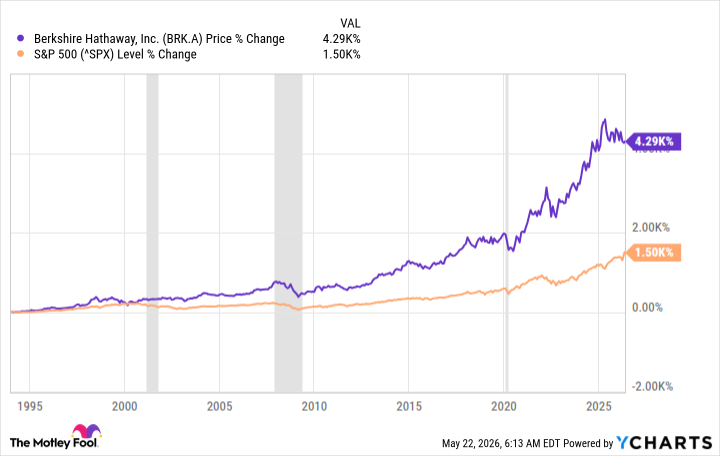
While the graph above highlights Warren Buffett’s impressive investment results at Berkshire Hathaway, there’s another, more subtle takeaway. There are three gray bars on the graph that highlight recessions. There have also been several bear markets over the period the graph covers. Berkshire Hathaway’s stock price has continued to head higher over time despite those headwinds, and so, too, has the S&P 500 index.
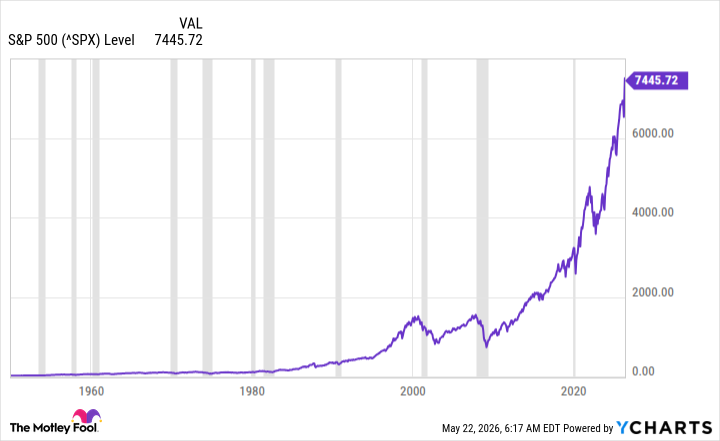
That trend goes much further back if you extend the S&P 500 graph. The chart below, for the S&P 500 index alone, goes back to the 1950s. There have been many recessions and bear markets since the 1950s, and not a single one has permanently derailed the market’s long, upward climb.
Yes, there are economic and stock market concerns today. Multiple geopolitical conflicts, high energy prices, recession fears, and a still lofty valuation for the S&P 500 are all legitimate sources of investor fear. But investors always have to deal with uncertainty and fear; it is part of the investment process.
History shows that deciding on a long-term plan (even one as simple as buying the S&P 500 index and holding it “forever”) and sticking to it is likely to lead to a good investment outcome. In other words, patient investors shouldn’t read too much into the market’s late May volatility.
Go long and keep going
Markets are volatile and always will be. You shouldn’t read into that volatility today or, frankly, any day. For most investors, the best outcome will likely come from finding an investment approach that works for you and sticking to it through the market’s inevitable good times and bad times. What is happening in May (or any month) shouldn’t sideline you from patiently building wealth over the long term.