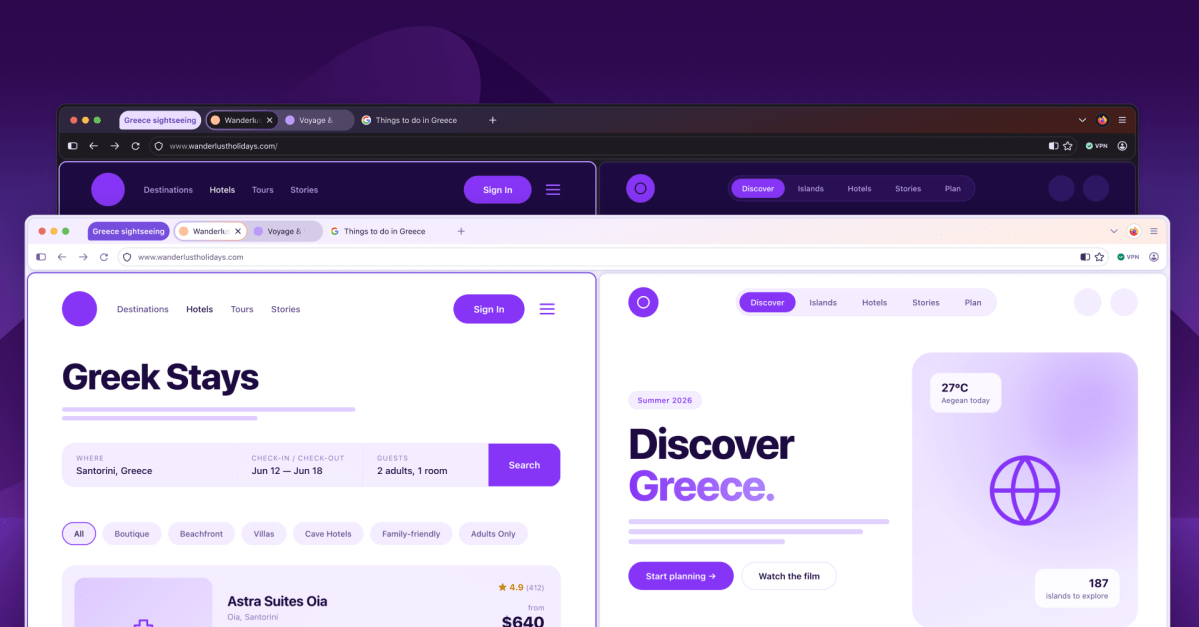






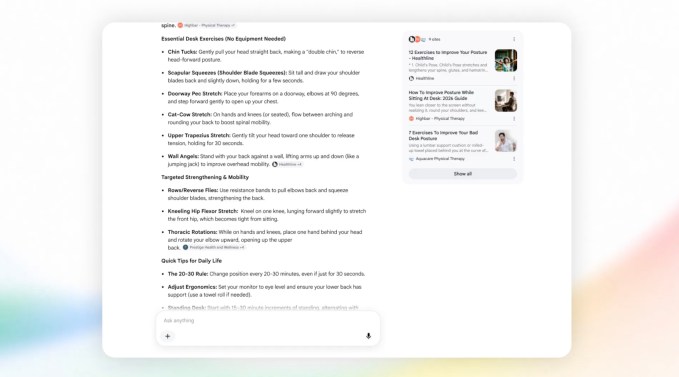
Google is about to look really different, and if you’re not a fan of the AI Overviews feature, then you’re not going to like what’s coming.
At the Google I/O 2026 keynote this week, the company announced that it is overhauling Search to embrace a conversational, AI-driven approach, even inviting users to enlist AI agents to automatically notify them if, for example, their favorite band were to go on tour.
“This is the biggest upgrade to our iconic search box since its debut over 25 years ago,” said Elizabeth Reid, leader of the Search organization at Google.
Now, when you search on Google, you’re given the option from the start to use AI mode. Even if you opt not to use AI mode, you might get a search result with an AI Overview, which will now include a chat box for you to ask follow-up questions. Once you open the chat box, Google begins to look more like ChatGPT than the search engine that’s ingrained itself into our lives for decades.
This announcement didn’t elicit the reaction that Google would’ve hoped for. Instead, many users see this as yet another example of a tech company squeezing AI agents and chatbots into everything it can, making it impossible to navigate the internet without encountering a chatbot. Especially after the rocky rollout of Google’s AI Overviews — remember when Google told people to stare into the sun? — users are not eager for another adjustment.

On Google’s video announcing the Search updates, one commenter wrote, “this is the best advertisement for letting people know it’s time to get a different search engine.”
They make a good point. The new Google Search, which Reid describes as “AI search through and through,” is sure to alienate users. Generative AI aside, some users have also grown weary of Google for its sheer dominance — a U.S. District Court ruled in 2024 that Google had acted illegally to maintain a monopoly in online search.
If you’re curious about alternative search engines, you’re in the right place. Here are some places to start (or, embrace chaos and see where Open Web Engine takes you).
Kagi
Before we were annoyed by Google’s AI Overview, we were annoyed by ads. Ads are non-negotiable for Google — that’s how Google Search makes money. But if a search engine were to operate without ads, could it still make money?
That’s what Kagi is trying to accomplish. For $5 per month — or $10 for unlimited searches — you can access an ad-free search engine without AI overviews.
Kagi isn’t just ad-free Google. The search engine also lets users customize their search experience by letting them filter certain websites and refine search results with “lenses.” If you’re in school, for example, you can use Kagi’s academic lens to find journal articles about a topic, rather than blog posts.
If you find Google’s AI Overviews useful from time to time, then you can use Kagi’s AI-powered “Quick Answer” feature to summarize an answer to your search and include links to its sources. But if you don’t want these AI summaries, guess what? You don’t have to generate them.
DuckDuckGo
Maybe you don’t want to pay to search stuff online. That’s understandable. DuckDuckGo offers a free search engine that makes money by selling ads, but unlike Google, it doesn’t collect user data in the form of search, browsing, and purchase history. Instead DuckDuckGo chooses what ads to serve based on the topic of your search — so if you search for concert tickets, you might see an ad for SeatGeek.
Like many alternative search engines, DuckDuckGo has an interface that’s reminiscent of Google — and like Google, it can display an AI-generated answer to a question in your search results. But if that bothers you, DuckDuckGo allows you to completely opt out of AI features in the settings menu.
Startpage
While DuckDuckGo has its own separate search index from Google, Startpage is a proxy for Google.
This means that Startpage acts as a middleman between you and the tech giant. When you search for something on Startpage, the company strips personal data like your IP address from your query, sends it to Google via the cloud, and returns the information to you. So, it’s Google without Google knowing who you are. The downside is, well, it’s still Google. At least Startpage lets you turn off AI features.
&udm=14
What if you took Startpage and made it simpler? The search engine &udm=14 is named for the string of characters it appends to all of your searches on Google.
If you add &udm=14 to your Google searches, you’ll get the same Google results, only without an AI overview. But doing that yourself after every search is pretty annoying. That’s why &udm=14 does it for you automatically.
The developer even put the code on GitHub so you can run your own version of &udm=14 if that’s your thing.
If you’re concerned about privacy, then you’d probably opt for Startpage over &udm=14, but both will basically get you AI-free Google.
Brave
Brave offers both a browser and a search engine. Since the browser is built atop Chromium, which is the same open-source base as Google Chrome, you can use Chrome extensions within the Brave browser. So, if you don’t want to use Google Chrome, but you can’t function without your LastPass plug-in, Brave could be for you.
In terms of search, Brave allows users to apply certain third-party “Goggles” (not Googles!) to their searches, which curate the results. These include “News from the Right,” “News from the Left,” “Tech Blogs,” and some other more niche options, like “Hacker News/1k short,” which prioritizes common domains referenced on Y-Combinator’s Hacker News forum, but without the 1,000 most popular domains, so it omits more mainstream sites. Then, there’s “No Pinterest,” which is pretty self-explanatory (and funny).
And yes, Brave does let you toggle AI features on and off. There’s no reason you can’t do this, Google.
Ecosia
Like Brave, Ecosia also offers both a browser and a search engine, and it’s also built atop Chromium, meaning that your Chrome plug-ins should work on Ecosia too. As its name suggests, Ecosia’s main draw is that it’s supposed to be more eco-friendly than other search platforms.
Ecosia makes money from ads, but it donates about 80% of its income to tree-planting initiatives around the world. Tree-planting can sometimes be a red flag for greenwashing, but Ecosia works with communities involved in local reforestation efforts, publishes monthly financial reports for transparency, and blogs about the actual impact of its efforts.
When you purchase through links in our articles, we may earn a small commission. This doesn’t affect our editorial independence.