







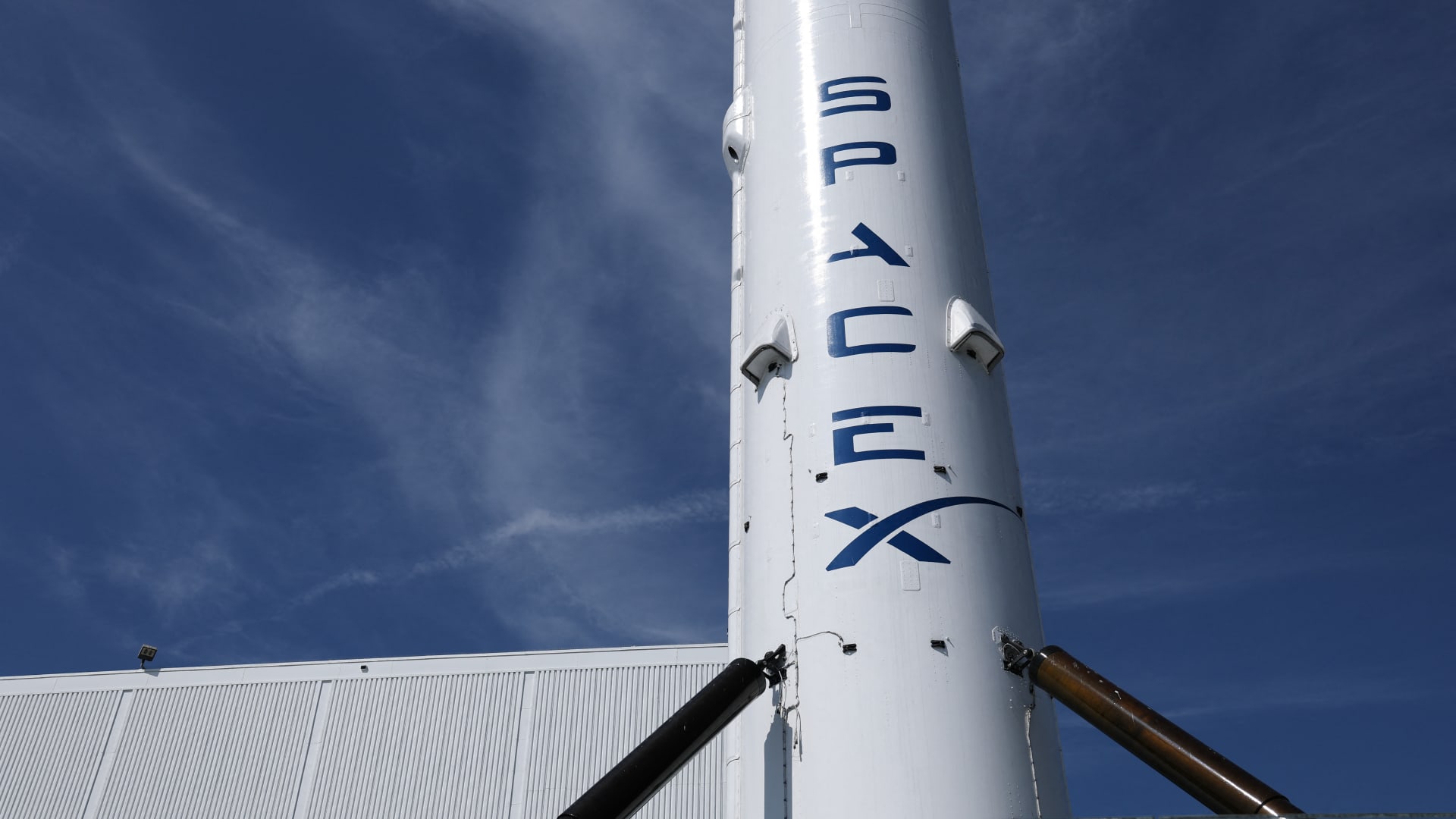
A SpaceX Falcon 9 rocket is displayed outside a Space Exploration Technologies Corp. facility in Hawthorne, California, on March 26, 2026.
Patrick T. Fallon | Afp | Getty Images
A slew of tech mega-IPOs are ahead and they’re set to push Warren Buffett aside on their first day of trading.
SpaceX on Wednesday officially filed to go public on the Nasdaq. On the same day, reports circulated that OpenAI will file for an IPO confidentially as soon as Friday.
After the OpenAI reports, traders on prediction market platform Kalshi now see a 92% chance that the ChatGPT owner files for an IPO this year. Traders also think its chief private rival, Anthropic, has 69% odds it will officially go public this year.
And according to traders on Polymarket, all are expected to trade on their first days at valuations north of $1 trillion, which would be records for a public debut.
SpaceX was valued at $1.25 trillion in February, and Polymarket traders think there’s a 56% chance it closes its first trading day above $2.2 trillion. OpenAI was last valued at $852 billion, and traders think there’s a 65% chance it ends its first public trading day above $1.4 trillion.
Meanwhile, traders place 47% odds that Anthropic on its first day of public trading will close above $1.8 trillion. The company reportedly is in talks for a new funding round at a $900 billion valuation.
Those valuations would place the companies firmly in the $1 trillion club, and likely above Berkshire Hathaway’s market cap, currently at $1.03 trillion. They’d even challenge Meta and Tesla’s around $1.5 trillion market caps.
Deutsche Bank analyst Adrian Cox pointed out in a Thursday note that Berkshire Hathaway had over $350 billion in revenue last year. That compares to SpaceX’s $18.67 billion in revenues during 2025. OpenAI reportedly generated $13.1 billion of revenue last year.
Anthropic’s revenues for 2025 aren’t as clear, but reports Wednesday said that the company is pacing for a second-quarter profit, a first for the Claude owner, at nearly $11 billion in revenue. SpaceX and OpenAI are unprofitable companies, despite their massive valuations.
The massive valuations come as companies have stayed private for longer, partially thanks to the growing number of ways to raise capital outside of public markets. But the rush of these IPOs in a row have created concerns there won’t be enough buyers to sustain these high valuations.
Cox threw cold water on those fears.
“While there may be concerns about the capacity of the market to absorb a number of IPOs valued at several hundred billion dollars this year, they would slot into an US stock market worth about $70trn overall,” he wrote. “That is five times larger in nominal terms than it was even at the peak of the dot-com bubble in the late 1990s. At that time, there was an average of almost 500 IPOs a year, compared with about 120 this decade.”
Disclosure: CNBC and Kalshi have a commercial relationship that includes a CNBC minority investment.