








Elon Musk’s xAI lost $6.4 billion from operations on just $3.2 billion in revenue in 2025, according to SpaceX’s IPO filings. And the losses are poised to grow. SpaceX’s filing reveals plans to scale Grok to “multiple trillions of parameters,” a dramatic boost that will likely require significant additional compute spend.
Elon Musk merged his AI company xAI — which had previously acquired his social media platform X (formerly Twitter) — with his rocket and satellite company SpaceX in February before announcing that he’d take the combined company public this year. While AI competitors OpenAI and Anthropic are also eyeing public debuts in 2026, SpaceX’s is expected to be one of the largest in history with a potential $1.75 trillion valuation.
The filing marks the first public glimpses into xAI, and therefore X’s, financials. In 2024, xAI recorded a loss of $1.56 billion on $2.62 billion in revenue. By 2025, losses had ballooned to $6.4 billion on $3.2 billion, meaning the gap between what xAI earns and spends is widening. Meanwhile, competitor (and customer) Anthropic reportedly expects a 130% revenue jump to $10.9 billion in the second quarter, leading to its first operating profit.
The jump in revenue from 2024 to 2025 came in large part from “AI solutions and infrastructure revenue” totalling $465 million, which includes $365 million in X and Grok subscription revenue, and $88 million in data licensing. An additional $116 million came from advertising.
AI segment capital expenditures climbed from $12.7 billion in 2025 to $7.7 billion in the first quarter of 2026 alone. That’s an annualized capex run rate of about $30.8 billion, more than doubling year-over-year.
So far, that investment has resulted in growing, but still limited, user numbers. Per the filing, SpaceX recorded 117 million monthly active users for Grok AI features as of March 2026, out of 550 million total MAUs across Grok and X combined. That implies only one-fifth of the combined ecosystem is actively using Grok AI features.
Still, SpaceX intends to soldier on with Grok; its next-generation AI is expected to scale to “multiple trillions of parameters,” which the filing describes as a “step change in reasoning in depth and overall intelligence.” It’s an ambitious target, and one that’s now recorded in the audited annals of SEC history.
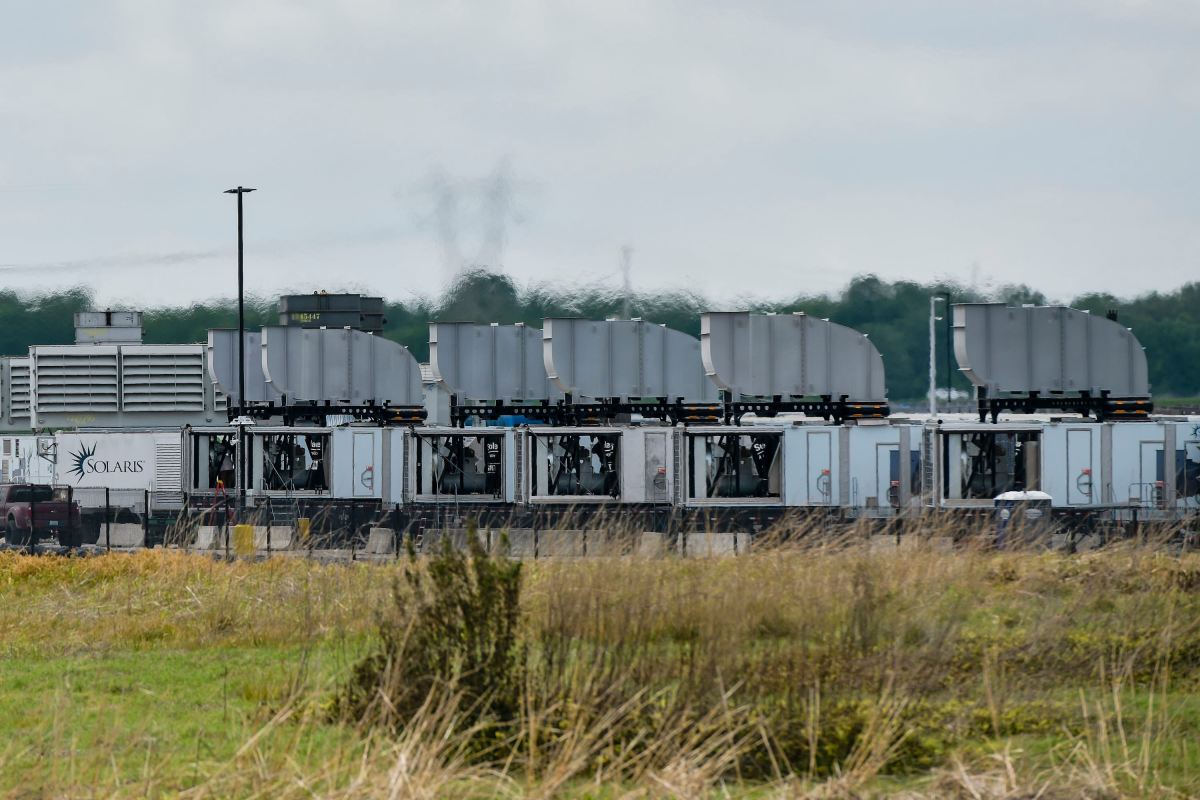
It’s also a target that will undoubtedly require more investment. The SpaceX filing’s “use of proceeds” section mentions an “expansion of our AI compute infrastructure.” Per the filing, xAI’s Colossus and Colossus II data centers — both of which came online in 122 days and 91 days, respectively — collectively provide about 1 gigawatt of compute power. These are both used for Grok’s training and inference. SpaceX claims that owning the compute infrastructure and vertically integrating across the AI stack lets them “train and iterate frontier models at lower cost and higher velocity.”
Another way that SpaceX might assuage investor fears about spending is by performing training and inference on orbital data centers, which Musk has promised to be a much cheaper alternative to terrestrial data centers. That sci-fi vision isn’t likely to happen for several years, though. The filing says SpaceX intends to begin deploying its orbital AI compute satellites as early as 2028 — the first concrete timeline set for such a launch.
“The future of AI will be determined by control of the physical stack,” the filing reads.
When you purchase through links in our articles, we may earn a small commission. This doesn’t affect our editorial independence.