








Investing is about balancing risk and reward. The bankruptcy of Spirit Airlines is yet another example of an investment risk that didn’t provide any reward at all. There are important lessons for investors who watched the airline’s financial decline, particularly if you lost money along the way. Here are three you should focus on.
1. Bankruptcy is a bad sign
It isn’t a joke to say that bankruptcy is a bad thing. Normally, a company has to seek court protection because it is financially troubled. Often, the problem is too much debt coupled with weak revenues and earnings. This is, basically, what led Spirit into bankruptcy the first time.

Image source: Getty Images.
While bankruptcy can help companies reduce leverage and trim costs, that doesn’t mean the business’s problems have been resolved. Buying a stock that has just emerged from bankruptcy is a high-risk investment decision. Only the most aggressive investors should consider such a move. It isn’t at all uncommon for companies to go from Chapter 11 bankruptcy to Chapter 22, as Spirit did.
That’s a finance industry joke, with Chapter 22 simply indicating a second bankruptcy. However, the point is that most investors should watch from the sidelines until a company has proven it has turned the corner before buying into it as it emerges from bankruptcy. Spirit is just the latest example of the risks that come with companies that go through bankruptcy.
2. It is bad when a struggling company’s merger falls apart
JetBlue (JBLU 0.39%) had agreed to buy Spirit, but the deal was effectively scuttled by regulators. That merger was akin to Spirit throwing a Hail Mary pass, as the airline looked to salvage something for shareholders. When that deal collapsed, the risk profile of investing in Spirit rose dramatically.

Today’s Change
(-0.39%) $-0.02
Current Price
$5.11
Key Data Points
Market Cap
$1.9B
Day’s Range
$5.03 – $5.24
52wk Range
$3.84 – $6.50
Volume
21M
Avg Vol
26M
Gross Margin
14.45%
That it eventually ended up in bankruptcy court isn’t the least bit surprising. In fact, the same thing happened to iRobot after its deal with Amazon (AMZN +0.55%) fell apart. You should tread with extreme caution when you see the Hail Mary pass from any struggling company fall short.
3. Leverage is a business killer
One of the key things that pushed Spirit into bankruptcy was high jet fuel prices, a byproduct of the geopolitical conflict unfolding in the Middle East. However, the real issue was leverage. The company’s debt levels left it with little room to maneuver in the face of adversity. That’s not uncommon in bankruptcy situations, but such risks are often well known prior to bankruptcy.
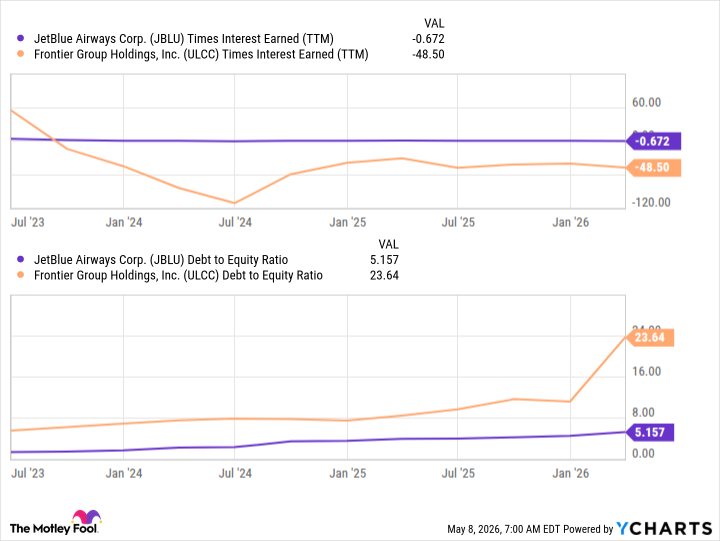
JBLU Times Interest Earned (TTM) data by YCharts
Specifically, for transportation stocks, investors need to pay close attention to balance sheets. This is because the assets required to operate a transportation business, such as an airline, are extremely expensive. If you own an airline stock, you should probably double-check its leverage, ability to cover interest costs, and get a sense of the magnitude of near-term maturities. Some industry watchers suggest that both JetBlue and Frontier Group (ULCC 2.58%) face elevated bankruptcy risk. (In hindsight, it might be a good thing that JetBlue didn’t buy Spirit.)
In other words, don’t assume that Spirit Airlines is the only airline that will be pushed into bankruptcy. Rising fuel costs could upend other airlines, as well.