







Leaving your lawn to develop naturally into a meadow of pollinator-friendly wildflowers is the best option from an ecological perspective. However, many of us still like to have at least a small area of grass, whether it’s to break up your flower beds or provide space for the kids to play. And while we encourage everyone to take part in No Mow May, you may be looking to buy a mower for the rest of the summer.
Your family’s lawnmower might have been a fossil fuel-guzzling petrol beast, but today, an electric model is far more energy-efficient and kinder to the planet. I’ve tested 10 electric mowers from nine manufacturers to find out which are the best.
At a glance
Why you should trust me
I’ve been mowing lawns since I was tall enough to be dragged around the garden by my father’s noisy and smelly petrol mower in the 1980s. Apart from a short period in early adulthood when accommodation didn’t really come with gardening responsibilities, I’ve been mowing my own lawn through the summer months for decades.
On occasion, I’ve managed to wrap that into my professional work, not as a gardener but as a product reviewer. I’ve tested and written about plenty of lawnmowers in recent years, and have picked up a thing or two about what makes a good one. Few things are quite as satisfying as being paid to test a mower on your own lawn on a sunny Friday afternoon, knowing that you’re simultaneously ticking off one of your weekend chores.
How I tested
A new patio was being laid in my back garden, so when the lawnmowers arrived at the front door, I gazed in despair at the builders’ yard of cement mixers, sand piles and pallets of slabs that were occupying my intended testing zone. Fortunately, the builders moved out as the last mower arrived, leaving a challenging space on which to test the mowers, with plenty of longer grass in places and bare earth elsewhere.
I assigned each mower a zone and tested it first on a relatively high cut setting to deal with longer grass, then took it down to 40mm or so. I have found this about right for mowing my slightly lumpy lawn without grounding the blade on its undulations.
I also tested how long the mowers could run for by mounting them on a makeshift rig, bypassing their safety features with a bootlace (don’t try this at home), and timing how long it took for the batteries to expire. I performed a similar test to see how long the batteries took to charge. The mowers with cables were plugged into a power meter to gauge how much power they drew from the mains.
Using the free Decibel X app on my smartphone, I measured the noise they made and also noted any special features, such as the size of the grass box and how well they cut to the edges.
All of the mowers here were loaned by the manufacturers and will be returned after testing. Any that aren’t collected will be donated to the British Heart Foundation.
The best electric lawnmowers in 2026
Best overall and best cordless lawnmower
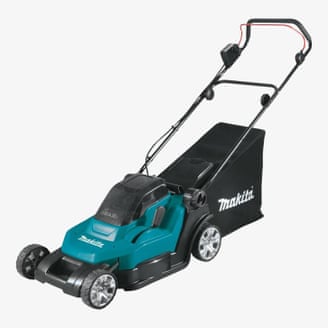
Makita DLM432PT2

Makita
DLM432PT2
from £399
What we love
A large-bladed mower with a long-lasting dual-battery system
What we don’t love
Finicky grass box; noisy charger

You’re more likely to know Makita for its power tools than its garden equipment, but this cordless lawnmower slots into the range well, coming with two 18V 5Ah batteries that work in series, and a large charging unit that can refill them both at the same time.
Why we love it
In practical terms, the large 43cm cutting blade means you can spend less time mowing, as each time you traverse your lawn, it cuts a wider strip than mowers with shorter blades. The downside is that it’s a bit heavier – there’s simply more steel involved.
When it came to cutting, the mower powered through my jobs, whether that was an initial cut of longer grass, or simply strimming a week’s growth off the top of the lawn. I found it easy to move around, and selecting the cutting height (from 20 to 75mm) was simple using the clearly labelled lever.
In tests, the two batteries lasted for more than 57 minutes – the longest lasting of all the battery-powered mowers in this group. It took only 51 minutes for the large, fan-cooled charger to take them back to full power.
It’s a shame that … the join between the grass box and the rear of the mower is a bit finicky, the manufacturer’s warranty is only a year, and the fan-cooled charger is noisy.
Cutting width: 43cm
Cutting height: 20-75mm
Weight: 15.6kg
Grass capacity: 40l
Corded/cordless: cordless
Battery life/charge time: 57mins 25secs/51mins 44secs
Spare batteries available: yes
Warranty: one year
Makita
DLM432PT2
from £399
What we love
A large-bladed mower with a long-lasting dual-battery system
What we don’t love
Finicky grass box; noisy charger
Best budget lawnmower:
Einhell GC-EM 1600/37

Einhell
GC-EM 1600/37
£130
What we love
Cheaper than battery models for a similar quality cut
What we don’t love
Some cable management required while mowing

If the other lawnmowers in this group look a bit pricey, consider a corded model instead. Without the added cost of batteries and chargers, corded mowers such as the Einhell GC-EM 1600/37 are much more affordable.
Why we love it
The main thing to love about the Einhell GC-EM 1600/37 is its price. It’s half the price of the most affordable battery mower here. Build quality isn’t quite what you might expect from a more expensive unit, but we can live with that considering the low price.
Without batteries to faff with, the mower is really easy to use. Once you’ve plugged it into an extension lead (which you’ll almost certainly need in any size of garden, despite the included 10m lead), you just press the start button and hold down the cutoff lever. The height of the cut can be adjusted between 20 and 60mm with its gear-stick-like notched lever, and its large rear wheels make it easy to manoeuvre.
I found the quality of the cutting easily on a par with the more expensive mowers here. Plus, it doesn’t suffer from the steady drop in power of battery-operated models, as their batteries drain.
It’s a shame that … mowing with a trailing cable is trickier than using a cordless model because you have to ensure you don’t mow over it.
Cutting width: 37cm
Cutting height: 20-60mm
Weight: 11.8kg
Grass capacity: 38l
Corded/cordless: corded
Cable length: 10m
Warranty: three years
Einhell
GC-EM 1600/37
£130
What we love
Cheaper than battery models for a similar quality cut
What we don’t love
Some cable management required while mowing
Best value cordless lawnmower and best lawnmower for small gardens:
Worx WG737E

What we love
Great value for money for a cordless mower
What we don’t love
Batteries take a long time to charge

The Worx WG737E is phenomenal value for money. Despite being the most affordable of the battery mowers, there’s little to distinguish the quality of its cutting from its more expensive rivals.
Why we love it
It won’t win any design awards, but plenty of thought has gone into the Worx WG737E’s core functionality, including an easy-to-see charge indicator that most rivals haven’t bothered with.
Its 37cm cutting blade is smaller than the Makita’s, making this mower more suitable for smaller gardens, but its 40-litre grass box is the same size, so you won’t have to empty it more often. The blade extends out as far as the outer edges of the wheels, so it’s good for cutting right up to the edges of your lawn, and it did a great job at slicing through the grass in my garden.
It also comes with a mulching accessory – a plastic insert that slots into the back of the mower that sees trimmings left on the ground to help feed and nourish the lawn. Other mowers offer this as an accessory, but this model includes one in the box.
It’s a shame that … batteries took more than four hours to recharge.
Cutting width: 37cm
Cutting height: 20-70mm
Weight: 14.9kg
Grass capacity: 40l
Corded/cordless: cordless
Battery life/charge time: 50mins 46secs/4hrs 10mins 32secs
Spare batteries available: yes
Warranty: three years
What we love
Great value for money for a cordless mower
What we don’t love
Batteries take a long time to charge
Best self-propelled lawnmower:
Mountfield SP185 Li kit

Mountfield
SP185 Li Kit
from £399
What we love
Self-propelled, so you don’t have to push it as hard
What we don’t love
Not as easy to wheel around as lighter, plastic mowers

In contrast to petrol mowers, most electric models don’t use their power to propel themselves across your lawn. Instead, the power from the battery goes into spinning the rotary blade, leaving you to manually push the mower up and down your lawn. The Mountfield SP185 Li kit is an anomaly, using its extra-powerful 48V 5Ah battery to drive the mower as well as the blade.
Why we love it
This electric mower looks and feels much more like a traditional petrol model, but without the fossil fuel. It’s a steel-bottomed beast, and weighs in at 25kg. Hold down the drive engagement lever, however, and off it zips.
The huge 46cm cutting blade means you won’t have to make as many passes across the lawn. However, the extra drain on the battery makes it less suitable for larger gardens than you may think. Mountfield suggests an upper limit of 550m2, but you can buy an extra battery (£179) to extend its range.
It’s a shame that … the drive engages with a bit of a jerk, and the mower is a bit stiff to turn when it’s not being powered.
Cutting width: 46cm
Cutting height: 22-65mm
Weight: 25kg
Grass capacity: 60l
Corded/cordless: cordless
Battery life/charge time: 24mins 54secs/1hour 24mins 35secs
Spare batteries available: yes
Warranty: five years
Mountfield
SP185 Li Kit
from £399
What we love
Self-propelled, so you don’t have to push it as hard
What we don’t love
Not as easy to wheel around as lighter, plastic mowers
Best robot lawnmower:
Husqvarna Automower 305E Nera

Husqvarna
Automower 305E NERA
£1,614.15
What we love
Mows the lawn almost as well as if you’d done it yourself
What we don’t love
Expensive and not smart enough to avoid small obstacles

If you usually dread the arrival of the weekly mowing season, then a good robot mower could revolutionise your summer. The problem with most is that they’re not as good as manual mowers – and I’ve tested a fair few. This one, however, proves me wrong.
Why we love it
I appreciate that this model is expensive; however, its design means you won’t have to do a follow-up mow around the lawn’s edges with a regular mower or trimmer.
Usually, the wheels on robot mowers sit beyond their blades, so they can’t reach the edge of the lawn without the mower falling off the edge. This mower solves that problem by including a second set of rotating blades at the rear. As it reaches the edge of its cutting area, it swings its back end around as it turns, taking its rear blades right to the edge of your lawn. It won’t trim right up to a wall or step, but it can get remarkably close.
It uses built-in satellite navigation to work out exactly where it needs to be, and can cut your lawn in a variety of efficient striped patterns.
It’s a shame that … it’s so very, very expensive.
Cutting width: 22cm
Cutting height: 20-55mm
Weight: 12.6kg
Grass capacity: none
Corded/cordless: cordless
Battery life/charge time: 31mins 53secs/44mins 11secs
Spare batteries available: no
Warranty: two years
Husqvarna
Automower 305E NERA
£1,614.15
What we love
Mows the lawn almost as well as if you’d done it yourself
What we don’t love
Expensive and not smart enough to avoid small obstacles
The best of the rest
Bosch Rotak 18V2-43

Bosch
Rotak 18V2-43
from £349
What we love
Covers large areas; long blade; capable battery life but …
What we don’t love
Batteries didn’t last as long as Makita’s in my tests

Best for: larger gardens
The Bosch Rotak 18V2-43 holds the record in this group for being the cordless manual mower that will cover the largest garden, with Bosch claiming it can handle up to 600m2. That played out in my battery test, with the mower lasting 37mins 46secs.
It has a large 43cm cutting area – as large as any of the plastic-based mowers here – and it cut my lawn brilliantly. I marginally prefer the Makita DLM432PT2 for its longer battery life, but this is almost as good if you’re already invested in tools that use the same 18V Power for All batteries. If you already own the charger and battery, there’s a cheaper option without them.
It didn’t make the final cut because … its batteries don’t keep the mower going as long as the Makita DLM432PT2.
Cutting width: 43cm; cutting height: 30-75mm; weight: 19.6kg; grass capacity: 50l; corded/cordless: cordless; battery life/charge time: 37mins 46secs/57mins 46secs (using Bosch AL 18V-44 charger, not supplied); spare batteries available: yes; warranty: three years
Bosch
Rotak 18V2-43
from £349
What we love
Covers large areas; long blade; capable battery life but …
What we don’t love
Batteries didn’t last as long as Makita’s in my tests
Black+Decker BEMW471BH-GB

Black+Decker
BEMW471BH-GB
from £122.95
What we love
Affordable, with additional cable management
What we don’t love
Still more finicky than a cordless model

Best for: a corded mower
This corded mower is a similar price to the Einhell GC-EM 1600/37 above, but it has a few features that improve on it. The slightly larger 38cm blade and 45l collection bin both might contribute to shaving a smidgen of effort off your mow. It can also leave your grass that bit longer, up to 70mm, and has a longer 12m cable.
You still have to wrestle with the cord while mowing, but Black+Decker includes some useful tips in its manual. And a simple but ingenious cord organiser fitted to the handle flips the cable from one side of the mower to the other when you turn a corner, keeping it out of the way of the mower and your feet.
It didn’t make the final cut because … its moulded rubber hand grips didn’t feel quite right.
Cutting width: 38cm; cutting height: 20-70mm; weight: 15.17kg; grass capacity: 45l; corded/cordless: corded; cable length: 12m; warranty: two years
Black+Decker
BEMW471BH-GB
from £122.95
What we love
Affordable, with additional cable management
What we don’t love
Still more finicky than a cordless model
Flymo 36V EasiHover 300

Flymo
36V EasiHover 300
from £299.99
What we love
Truly petite, ideal for smaller gardens and storage areas
What we don’t love
Battery doesn’t last very long

Best for: a hover mower
If your lawn and storage space are small, this compact and light hover mower may be just the job. Flymo rates it to cover only 100m2, and it has a tiny 20l collection box. However, it weighs just 9.7kg, and the handle folds up and over, so it can be stored standing on its end.
The Flymo doesn’t offer much range in cutting height, with only 10, 20 and 30mm available. Changing the height is also a bit of a pain, requiring you to remove the blade and add a spacer or two, although the spacers and blade removal spanner are included in the box.
It didn’t make the final cut because … the batteries lasted only 11mins 30secs in my tests.
Cutting width: 30cm; cutting height: 10-30mm; weight: 9.7kg; grass capacity: 20l; corded/cordless: cordless; battery life/charge time: 11mins 30secs/1hr 53mins 24secs; spare batteries available: yes; warranty: three years
Flymo
36V EasiHover 300
from £299.99
What we love
Truly petite, ideal for smaller gardens and storage areas
What we don’t love
Battery doesn’t last very long
Stihl RMA 239 C

What we love
Compact to store, easy to empty collection box
What we don’t love
Harder to push around than most of its rivals

Best for: easy emptying
Most of the lawnmowers here fold up into a relatively small space, but the Stihl RMA 239 C takes this a step further. It has a single arm, hinged from a sturdy metal clip, so getting it from stowed to ready for action takes just seconds. Unscrewing the handle bolts on all the others isn’t an enormous chore, but this is markedly better. Only the tiny Flymo 36V EasiHOver 300 folds up smaller.
I also liked the grass-collection box: it has a chute that extends out of the box and down into the mower’s internals. When you remove the box, it is already holding all the grass that usually spills out.
It didn’t make the final cut because … I found the starting process more awkward than on the other mowers, and it didn’t wheel around as smoothly, particularly at the end of a line.
Cutting width: 37cm; cutting height: 20-70mm; weight: 16.3kg; grass capacity: 40l; corded/cordless: cordless; battery life/charge time: 43mins 3secs/2hrs 35mins 26secs; spare batteries available: yes; warranty: five years
What we love
Compact to store, easy to empty collection box
What we don’t love
Harder to push around than most of its rivals
What you need to know
What are the different types of lawnmower?
Broadly speaking, there are two types of lawnmower: cylinder and rotary. Cylinder mowers use a set of long blades attached to a cylindrical frame, which is rolled over the lawn to slice the top off the grass as it goes. Rotary mowers are now more common and use a rotating blade that spins beneath the mower, like an upside down helicopter blade, slicing the grass as it goes. Rotary mowers may have wheels to keep them above the grass, or may create a cushion of air underneath them, like a hovercraft. The latter type is known as a hover mower, and is particularly useful if you need to manoeuvre around a lot of tricky areas, such as around trees.
Mowers are typically powered by either petrol or electricity, with the latter using either batteries (cordless) or plugging in to a domestic power supply (corded). The engines on petrol mowers tend to be quite heavy and will often drive the mower forwards as well as spinning the blades. Electric mowers are more likely to save their power for spinning the blades, requiring the user to push the mower around manually.
How to make your lawnmower last longer
Petrol lawnmowers benefit from annual servicing. If you’re mechanically minded, you can do this yourself; otherwise, there are plenty of mechanics and mower servicing companies that will do it for you.
All mowers can benefit from being wiped down with a damp cloth after use to remove any loose clippings, which helps prevent rust on the blades and keeps them from clogging up with dried grass. Take care around the blades.
During the winter, it’s worth having your mower blades sharpened, ready for spring. Check your mower’s manual to see if they can be removed and taken to a high-street sharpener, or get it included in an annual service.
How to sharpen lawnmower blades
It’s possible to sharpen your own lawnmower blade. However, if you’re nervous or don’t have the right tools, seek out a professional or get help from someone who knows what they’re doing.
Always unplug and/or remove the battery from your lawnmower before you start working. Wear gloves when removing the blade to protect your hands; it’s usually attached to the underside with a nut or two. Once removed, use a table vice to hold the blade or use clamps to secure it to a workbench.
You can sharpen a blade manually using a metal file. Put on some eye protection and file in one direction, away from yourself and towards the sharp edge, using the existing edge to guide the angle. If you’d prefer a less manual approach, there are sharpening tools made for this kind of job, such as sharpening stones you can mount on a power drill.
It’s important to keep the blade balanced, so file off the same amount on each side of the blade. Check this with a balancing tool, or just hang the blade from a nail and see that it doesn’t tip one way or the other. When you’ve finished, replace the blade and tighten the bolts securely before replacing the battery.
Can you rent a lawnmower?
Yes. Not everyone needs to own a lawnmower, particularly if you don’t intend to mow that often. Leaving the grass to grow longer and cutting less frequently is better for wildlife, including pollinating insects. Those with smaller gardens and little space to store bulky machinery can also benefit from renting a mower.
There are plenty of tool hire services, such as HSS and Speedy Hire, that operate across the country. Most of these nationwide services tend to rent out heavier-duty petrol mowers, best suited to larger gardens and bigger jobs. Prices start at about £35 a day.
If you live in the Greater London area, you can rent the Stihl RMA 339 lawnmower from Library of Things for £16 a day and pick it up from a central storage area. Unfortunately, I couldn’t find a similar service that operates elsewhere (please let us know if you know of one). If you think you’ll mow the lawn once a week from mid-March to mid-October, which is at least 30 weeks, then it’ll cost £480 for the year.
For even better value, you could hire a mower from an owner who lends out their equipment. Hygglo facilitates this, taking a cut of the fee for bringing people together. Mowers typically cost about £10/day or £40/week. It operates across the country, though there tends to be more choice and availability in higher-populated areas.
What to do with your grass clippings
If you have a compost heap, clippings make a good additional source of nitrogen. However, you need to add other stuff to it to stop it from turning into a slimy slurry. Ripped-up newspaper, cardboard and shredded bills are a good way to add necessary carbon. Mix it up well.
Clippings also make good mulch, which you can sprinkle around almost any plants to suppress weeds and add soil as it breaks down.
It’s even possible to leave your grass clippings on your lawn to mulch and feed itself. Robot lawnmowers operate on this principle, but they tend to come out on a daily basis, which keeps the length of the clippings to a minimum. With a weekly manual mow, the cuttings will be longer. You’re likely to be able to see the grass cuttings on your lawn as they discolour and break down, and you may pick them up on your feet whenever you walk across it.
What to do with your old lawnmower
If your old lawnmower is still working, consider donating it to charity, selling it on, or giving it to someone who might need it. Local charities may offer a collection service, or someone looking for a bargain on social media might be prepared to pick it up.
If you have to dispose of an old mower, take it to your local recycling centre. Battery-powered mowers can be left in the electrical section. Petrol mowers should be emptied of fuel and oil, and may then be suitable for scrap metal recycling, but check with local staff first.
Is lawn mowing a good workout?
Yes, mowing the lawn is an excellent workout. The NHS’s physical activity guidelines for adults (aged 19-64) and older adults (over 64) suggest that pushing a lawnmower is a good source of moderate exercise, similar to water aerobics or riding a bike.
However, the NHS recommends at least 150 minutes (two and a half hours) of moderate intensity exercise every week, so unless your garden is huge, it’s unlikely to be the only workout you need.
Andy Shaw is a consumer journalist and technology addict. Having reviewed tech products professionally for more than 30 years, his favoured working environment is a small desk surrounded by big boxes. His greatest weakness is that he never, ever remembers how things came out of their packaging, so they rarely fit back in again when it’s time to return them
This article was amended on 1 April 2026. An earlier review of the Makita DLM432PT2 lawnmower said that two batteries worked in parallel; that should have said that they worked in series.